
22q11.2 Deletion Syndrome Market Size in the 7MM is projected to grow at a significant CAGR over the forecast period of 2026-2036 | DelveInsight
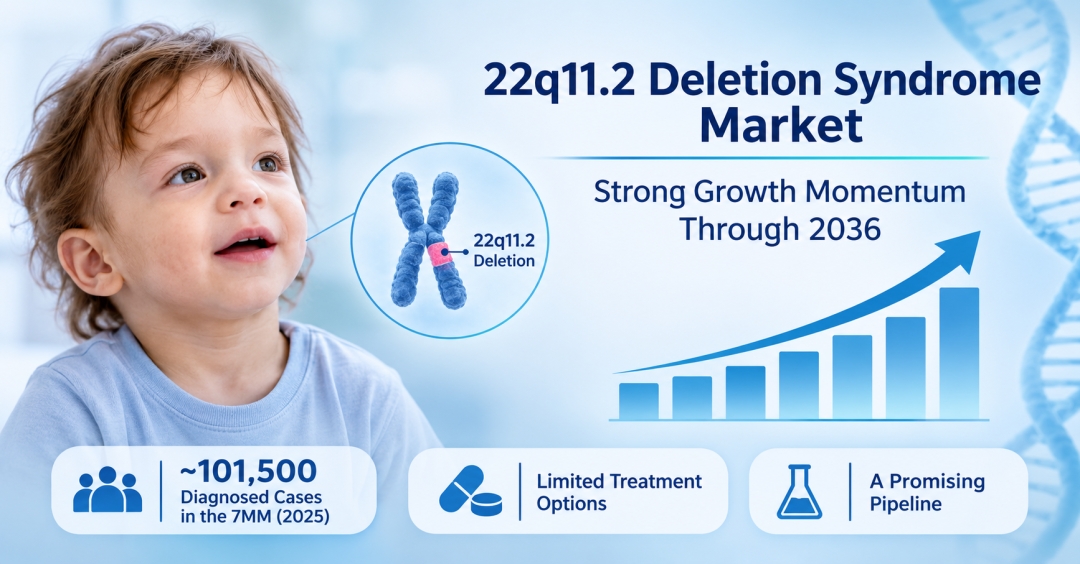
(Albany, US), November 3, 2026 – DelveInsight’s ’22q11.2 Deletion Syndrome Market Insights, Epidemiology and Market Forecast – 2036′ report delivers an in-depth understanding of 22q11.2 Deletion Syndrome, historical and forecasted epidemiology, as well as the 22q11.2 deletion syndrome market trends in the United States, EU4 (Germany, Spain, Italy, and France) and the United Kingdom, and Japan.
Explore the intricate details of the 22q11.2 Deletion Syndrome Market Report @ 22q11.2 Deletion Syndrome Market Forecast
Key Takeaways from the 22q11.2 Deletion Syndrome Market Report
-
As per Harmony Biosciences’ Q3 2025 presentation, the Zygel (ZYN002) development program in 22q11.2 deletion syndrome has been paused pending the full review of the RECONNECT data.
-
In June 2025, Nobias Therapeutics secured preliminary alignment with the US FDA on registrational endpoints for NB-001 for the treatment of neuropsychiatric symptoms associated with 22q11.2 deletion syndrome, clarifying regulatory expectations for potential approval.
-
The 22q11.2 deletion syndrome market size was valued at approximately USD 14 million in 2025 and is projected to grow at a CAGR of ~32% during 2026-2036.
-
According to DelveInsight’s analysis, among the 7MM, the United States accounted for the largest 22q11.2 deletion syndrome market size, at approximately USD 8 million in 2025.
-
According to DelveInsight’s estimates, the total number of diagnosed prevalent cases of 22q11.2 deletion syndrome in the 7MM was approximately 101,500 in 2025.
-
In EU4 and the UK, Germany and the UK captured the largest share of the 22q11.2 deletion syndrome market, while Spain accounted for the least share.
-
There are no FDA-approved disease-modifying therapies for 22q11.2 deletion syndrome, and treatment is limited to supportive interventions such as cardiac surgery, calcium supplementation, immune support, and psychiatric management.
-
The emerging pipeline remains highly limited, with a few investigational therapies in development, including NB-001 (Nobias Therapeutics).
-
The leading 22q11.2 Deletion Syndrome Companies include Sumitomo Pharma, Enzyvant, Roivant Sciences, Zynerba Pharmaceuticals, Harmony Biosciences, Nobias Therapeutics, and others.
-
Promising 22q11.2 Deletion Syndrome Therapies include RETHYMIC, NB-001, and others.
Get a Free sample for the 22q11.2 Deletion Syndrome Market Forecast, Size & Share Analysis Report @ 22q11.2 Deletion Syndrome Market Size
22q11.2 Deletion Syndrome Overview
22q11.2 Deletion Syndrome, also known as DiGeorge syndrome or velocardiofacial syndrome, is a genetic disorder caused by a hemizygous microdeletion on chromosome 22q11.2, leading to haploinsufficiency of critical developmental genes, particularly TBX1. The 22q11 microdeletion produces multisystem manifestations, including conotruncal congenital heart defects, thymic hypoplasia with immune dysfunction, hypoparathyroidism-associated hypocalcemia, and distinct craniofacial features, along with significant neurodevelopmental and psychiatric manifestations such as learning disabilities, autism spectrum disorder, and a markedly increased risk of schizophrenia (~25% in adults). As the most common chromosomal microdeletion syndrome, it carries an estimated prevalence of ~1 in 3,000–4,000 live births; however, variable expressivity and age-dependent clinical evolution often lead to underdiagnosis, particularly in individuals without major congenital anomalies. Diagnosis is genetically confirmed, with chromosomal microarray (CMA) as the current gold standard, enabling detection of both typical (~3 Mb) and smaller nested deletions, while FISH is now less preferred due to limited sensitivity for atypical variants. This growing reliance on CMA is also relevant to the France microarray market and Italy microarray market, given the inclusion of both countries in the EU4 coverage. Increasing adoption of genomic-first approaches and prenatal screening (NIPT) is improving early detection, although milder phenotypes continue to be diagnosed later in childhood or adulthood.
22q11.2 Deletion Syndrome Epidemiology Segmentation in the 7MM
-
Total Prevalent Cases of 22q11.2 Deletion Syndrome
-
Total Diagnosed Prevalent Cases of 22q11.2 Deletion Syndrome
-
Age-specific Diagnosed Prevalent Cases of 22q11.2 Deletion Syndrome
-
Total Diagnosed Prevalent Cases of 22q11.2 Deletion Syndrome with Behavioral and Psychiatric Phenotypes
-
Total Treated Cases of 22q11.2 Deletion Syndrome
Download the report to understand which factors are driving 22q11.2 Deletion Syndrome Epidemiology trends @ 22q11.2 Deletion Syndrome Prevalence
22q11.2 Deletion Syndrome Epidemiology Key Findings
-
Discussions around Orphanet 22q11.2 deletion syndrome prevalence and the wider 22q11.2 deletion syndrome prevalence literature place the condition at approximately 1 in 3,000–4,000 live births, making it the most common chromosomal microdeletion syndrome.
-
In 2025, the total number of diagnosed prevalent cases of 22q11.2 deletion syndrome in the 7MM was approximately 101,500.
-
In the United States in 2025, age-specific diagnosed prevalent cases included approximately 12,550 infants, ~10,300 cases aged 1–5 years, ~19,550 cases aged 6–12 years, ~7,000 cases aged 18+ years, and ~4,800 cases aged 13–17 years.
-
Among EU4 and the UK, Germany accounted for the highest number of diagnosed prevalent cases (~9,300 cases), while Spain reported the lowest burden (~6,100 cases) in 2025, highlighting regional variability in diagnosis and disease recognition.
-
In Japan, diagnosed prevalent cases of 22q11.2 deletion syndrome with behavioral and psychiatric phenotypes were approximately 7,650 in 2025.
Approved Therapies for 22q11.2 Deletion Syndrome
-
RETHYMIC (formerly RVT-802): Sumitomo Pharma/Enzyvant/Roivant Sciences
RETHYMIC is a thymus tissue–based regenerative therapy indicated for patients with congenital athymia, a rare and life-threatening immune deficiency often associated with 22q11.2 Deletion Syndrome. The therapy involves implantation of allogeneic cultured thymus tissue to restore T-cell development and immune function, addressing the underlying cause of immunodeficiency. Originally developed by Enzyvant, it received Breakthrough Therapy and Regenerative Medicine Advanced Therapy (RMAT) designations from the US FDA. Approved in 2021, RETHYMIC represents a first-in-class, disease-modifying treatment option with the potential to significantly improve survival and immune reconstitution in affected pediatric patients.
22q11.2 Deletion Syndrome Pipeline Analysis
-
NB-001: Nobias Therapeutics
Fasoracetam add tag: NB-001 (fasoracetam) is an investigational non-stimulant activator of multiple metabotropic glutamate receptors (mGluRs) targeting disrupted neuronal signaling underlying cognitive and psychiatric symptoms in 22q11.2 deletion syndrome. By modulating synaptic plasticity and key neurobiological pathways, it aims to deliver disease-modifying benefits beyond symptomatic management. The drug has completed a Phase II clinical trial, demonstrated favorable safety and encouraging improvements in anxiety, ADHD, and behavioral symptoms, and has received the FDA’s Rare Pediatric Disease (RPD) designation.
-
Zygel (ZYN002): Zynerba Pharmaceuticals/Harmony Biosciences
Zygel is a THC-free transdermal cannabidiol gel developed for behavioral symptoms in 22q11.2 deletion syndrome, using a transdermal route to ensure stable exposure and improved tolerability. The Phase II INSPIRE study, initiated in 2020, demonstrated by 2022 meaningful improvements in anxiety, mood, and behavior with a favorable safety profile. Despite FDA orphan drug designation, development in 22q11.2 deletion syndrome has been paused pending a full review of data from the RECONNECT trial in Fragile X syndrome.
Discover more about therapies set to grab Major 22q11.2 Deletion Syndrome Market Share @ 22q11.2 Deletion Syndrome Market Drivers and Barriers
22q11.2 Deletion Syndrome Market Outlook
There is currently no curative therapy for 22q11.2 deletion syndrome, and management remains largely supportive and multidisciplinary. Treatment is tailored to clinical severity, age, and organ involvement, with early-life focus on congenital heart defects, immune dysfunction, hypocalcemia, feeding issues, and palatal abnormalities, shifting toward neurodevelopmental, cognitive, and psychiatric management as patients age. While these approaches have improved survival, they do not address the underlying genetic defect, leaving significant unmet needs. The DiGeorge syndrome market is therefore poised for steady evolution, driven by rising awareness and early but promising targeted therapies. Despite cautious pipeline progression and strategic pauses, emerging mechanism-based treatments are expected to gradually shape growth of the 22q11.2 deletion syndrome market across the 7MM from 2022–2036, as rare disease care advances in the 21st century. Regulatory alignment on registrational endpoints for NB-001 marks a critical inflection point, signaling increased development maturity, reducing approval uncertainty, and reinforcing momentum toward the first disease-specific therapies. The entry of NB-001 is expected to capture a significant share of the landscape.
22q11.2 Deletion Syndrome Market Drivers
-
Advancements in genetic testing and diagnosis, including improved molecular diagnostics and prenatal screening
-
Increasing awareness of rare genetic disorders among healthcare professionals, caregivers, and patient advocacy organizations
-
Growing research and development activities by pharmaceutical and biotechnology companies
-
Supportive government and regulatory initiatives, including orphan drug incentives and research funding
-
Rising demand for multidisciplinary care across cardiac, immunological, neurological, and developmental complications
22q11.2 Deletion Syndrome Market Barriers
-
Low Disease Awareness: Limited awareness leads to delayed diagnosis.
-
High Diagnostic Costs: Expensive genetic testing restricts accessibility.
-
Limited Treatment Options: No definitive cure or targeted therapies.
-
Small Patient Pool: Challenges clinical trials and market growth.
-
Reimbursement Barriers: Limited insurance coverage affects treatment adoption.
22q11.2 Deletion Syndrome Treatment Landscape
Management of 22q11.2 Deletion Syndrome is supportive, symptom-driven, and requires lifelong multidisciplinary care, as no disease-modifying therapies are currently available. Treatment focuses on organ-specific manifestations, including surgical correction of congenital heart defects, calcium and vitamin D supplementation for hypocalcemia, and immune management ranging from infection prophylaxis to immunoglobulin replacement in selected patients, with thymus transplantation reserved for severe T-cell deficiency. Additional interventions include surgical repair of palatal abnormalities, early speech, occupational, and behavioral therapies for developmental delays, and psychiatric management for conditions such as ADHD, anxiety, and schizophrenia. Care coordination across specialties is critical to optimize long-term outcomes and quality of life.
To know more about 22q11.2 Deletion Syndrome Companies working in the treatment market, visit @ 22q11.2 Deletion Syndrome Market Access and Reimbursement
Scope of the 22q11.2 Deletion Syndrome Market Report
-
Coverage- 7MM
-
Study Period- 2022-2036
-
Forecast Period- 2026-2036
-
22q11.2 Deletion Syndrome Companies- Sumitomo Pharma, Enzyvant, Roivant Sciences, Zynerba Pharmaceuticals, Harmony Biosciences, Nobias Therapeutics, and others.
-
22q11.2 Deletion Syndrome Therapies- RETHYMIC, NB-001, and others.
-
22q11.2 Deletion Syndrome Market Dynamics: Market drivers and market barriers
-
22q11.2 Deletion Syndrome Competitive Intelligence Analysis: SWOT Analysis, Conjoint Analysis
-
22q11.2 Deletion Syndrome Unmet Needs, KOL Views, Reimbursement
Table of Contents
-
Key Insights
-
Report Introduction
-
Executive Summary of 22q11.2 Deletion Syndrome
-
Key Events
-
Epidemiology and Market Forecast Methodology
-
22q11.2 Deletion Syndrome Market Overview at a Glance
-
Disease Background and Overview
-
Treatment
-
Epidemiology and Patient Population
-
Patient Journey of 22q11.2 Deletion Syndrome
-
Key Endpoints Guidance by the FDA
-
Approved Therapies
-
Emerging Therapies
-
22q11.2 Deletion Syndrome: 7MM Analysis
-
KOL Views of 22q11.2 Deletion Syndrome
-
Unmet Needs of 22q11.2 Deletion Syndrome
-
SWOT Analysis of 22q11.2 Deletion Syndrome
-
Market Access and Reimbursement of 22q11.2 Deletion Syndrome
-
Appendix
-
DelveInsight Capabilities
-
Disclaimer
-
About DelveInsight
Media Contact
Company Name: DelveInsight Business Research LLP
Contact Person: Abhishek kumar
Email: Send Email
Phone: +19193216187
Address:304 S. Jones Blvd #2432
City: Albany
State: New York
Country: United States
Website: https://www.delveinsight.com/report-store/22q112-deletion-syndrome-market


