
How to Source LED Skincare Masks: Verifying Wavelength Claims and FDA Compliance for Beauty Brands
Ningbo, Zhejiang, China – October 22, 2026 – Why Wavelength and FDA Compliance Are the Two Biggest Sourcing Risks in LED Skincare Masks: The LED skincare mask category has grown substantially in the past three years, driven by consumer awareness of phototherapy, the expansion of the at-home beauty device market, and the entry of private-label beauty brands seeking differentiated OEM products. This growth has attracted a wide range of Chinese manufacturers, from established factories with proper test documentation to trading companies relabelling generic products with inflated wavelength and efficacy claims.
For beauty brands entering the LED mask category, the two most significant procurement risks are wavelength accuracy and regulatory compliance. A mask claiming 630nm red light that actually emits 625nm with a plus or minus 15nm bin tolerance may be legally saleable but therapeutically ineffective, creating customer returns and regulatory exposure. A mask with anti-acne claims and no FDA device clearance may be seized at US customs.
Because LED phototherapy efficacy is wavelength-specific at the point of the LED emitter — determined by the semiconductor bandgap chemistry — so the wavelength claim on a spec sheet is the single most important technical parameter to verify before committing to a purchase order.
This guide walks through five procurement considerations for OEM LED skincare mask sourcing: wavelength verification, FDA device classification, CE/FCC/RoHS certification, factory quality system audits, and documentation completeness. The framework applies to beauty brands importing from China for the US market, European market, or both.
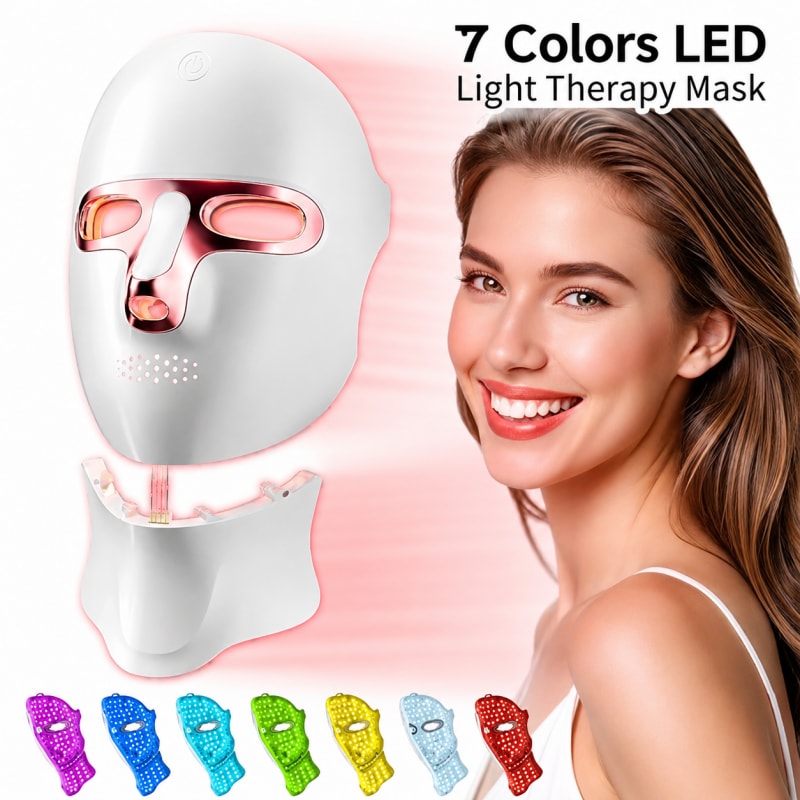
7-color LED light therapy face and neck mask, Model QK-D06 — 120 LEDs across a full 7-color spectrum with face-and-neck coverage. Manufactured by Ningbo Pinren Electric Appliance Co., Ltd.
Consideration 1 — Wavelength Verification: The Most Commonly Faked Specification
LED phototherapy in skincare depends on specific wavelengths being absorbed by chromophores in skin cells. Red light at 630-660nm stimulates ATP production and collagen synthesis; blue light at 415-470nm destroys acne bacteria; near-infrared at 850-880nm penetrates deeper tissue for anti-inflammatory responses.
If the LED emitters in a mask are binned at the wrong centre wavelength, the photochemical reaction that produces the claimed skin benefit does not occur, regardless of how many LEDs the mask contains.
Because LED manufacturing involves wavelength binning — sorting emitters by their actual output wavelength after production — so a supplier purchasing LEDs from the lowest-cost bin can produce a mask that claims 630nm red while actually emitting at 615nm or 645nm, outside the clinically effective window.
The authoritative evidence of wavelength accuracy is a spectrometer test report from an ISO 17025 accredited testing laboratory stating the centre wavelength, peak wavelength, and spectral bandwidth (FWHM) for each LED colour. The centre wavelength, not the nominal marketing wavelength, is what to compare against clinical literature.
For a mask claiming red light therapy, the centre wavelength should fall between 630nm and 660nm. For blue light acne treatment, the centre wavelength should fall between 415nm and 470nm. A centre wavelength of 612nm for a red LED is a green LED misrepresented as red — reject the product before tooling investment.
A secondary verification step is to ask for the LED binning specification from the LED manufacturer’s datasheet, which states the bin code and wavelength range for the LEDs used. A quality supplier will share this documentation as a matter of course.
Consideration 2 — FDA Device Classification: Which Requirements Actually Apply
The US FDA regulates electronic skincare devices under the Federal Food, Drug, and Cosmetic Act. For LED skincare masks, there are two distinct regulatory requirements: FDA Establishment Registration and FDA Premarket Review.
FDA Establishment Registration (21 CFR Part 807) requires any foreign or domestic facility manufacturing or distributing medical devices in the US to register annually with the FDA through the FURLS system. This is a facility listing — it confirms the FDA knows the factory exists and can inspect it — not a determination of device safety or efficacy. Foreign facilities require a US Agent under 21 CFR Part 807.
Because the FDA has been increasing import alerts on beauty devices making medical claims without documented clearance, so beauty brands importing LED masks with anti-acne or anti-aging claims face genuine import risk if the manufacturer lacks required premarket clearance.
The second regulatory layer is premarket review. If an LED skincare mask is marketed with medical claims — treating acne vulgaris, reducing wrinkles, or lightening hyperpigmentation — it likely qualifies as a Class II device under 21 CFR Part 882 if the intended use is similar to previously cleared LED therapy devices.
Class II devices require a 510(k) Premarket Notification demonstrating Substantial Equivalence (SE) to a legally marketed predicate device, demonstrating the device is at least as safe and effective as the predicate. The 510(k) process typically takes 3-6 months and requires electrical safety, EMC testing, and sometimes clinical performance data.
Some LED mask suppliers market their products as wellness devices to avoid the 510(k) requirement. If sold without medical claims, the product may not meet the FDA definition of a medical device and may enter the US market without device clearance. This approach carries risk: the FDA has issued warning letters to companies marketing LED devices with implied medical claims through product names, imagery, website copy, and testimonials.
Consideration 3 — CE/FCC/RoHS: The Non-Negotiable Market Access Certifications
CE marking is mandatory for LED skincare masks sold in the European Economic Area (EEA). Key applicable directives include LVD 2014/35/EU for electrical safety, EMC Directive 2014/30/EU for emissions and immunity, and RoHS Directive 2011/65/EU for hazardous substance restriction. Because CE marking is a self-declaration regime — the manufacturer affixes the CE mark based on its own Technical File without prior government testing — the credibility of the CE mark depends entirely on the quality of test reports from an accredited laboratory.
The FCC requires Part 15 certification for LED skincare masks containing digital circuitry. Most LED masks with microcontroller-based timing circuits fall under FCC Part 15 Class B, limiting radiated emissions to protect broadcast reception. FCC testing must be conducted at an FCC-recognized accredited testing laboratory, and the test report is filed with an FCC registration number (FRN). The supplier should provide the FCC test report and the FCC ID number.
The most important due diligence step in OEM LED mask procurement is verifying the authenticity of compliance test reports. Cross-check the laboratory accreditation number on the test report against the A2LA accreditation directory or IAS accreditation directory to confirm the lab is accredited for the specific test standard cited. Request the original PDF of the test report to verify the digital signature and metadata. Confirm that the test sample model number matches the product being ordered.
Consideration 4 — Factory Quality System: What to Verify Before Committing to an OEM Order
An ISO 9001:2015 quality management system certificate from an accredited certification body is the minimum quality standard a serious LED mask OEM manufacturer should hold, confirming documented procedures for product design, incoming inspection, production control, and final testing.
For OEM orders of 500 units or more, engaging a third-party inspection company such as QIMA, Asia Quality Focus, or Bureau Veritas for a pre-shipment inspection is strongly recommended. The audit should cover LED incoming inspection procedure, assembly ESD protection measures, and whether every finished unit is tested for wavelength output or only sampled. Third-party inspection companies such as QIMA, Asia Quality Focus, or Bureau Veritas offer pre-shipment inspection services for Chinese manufacturing suppliers.
Because LED emitters from the same production batch can vary in wavelength bin by plus or minus 5nm, so a factory testing only a sample of units cannot guarantee that every unit in a 500-unit order meets the specified wavelength band.
LED skincare masks with built-in rechargeable batteries must comply with IEC 62133. The battery is the highest-risk component in a battery-powered beauty device. The documentation package should include the battery manufacturer’s IEC 62133 test report, battery protection circuit board (PCM) specification, and battery capacity and voltage test report. The OEM manufacturer should provide a battery safety test report for the complete assembled product.
Consideration 5 — Documentation Package: What a Procurement-Ready OEM Supplier Should Provide
A procurement-ready documentation package should include: (1) ISO 9001 quality management system certificate; (2) independent spectrometer wavelength test report from an ISO 17025 accredited laboratory; (3) CE/FCC/RoHS test reports from an accredited third-party laboratory; (4) FDA Establishment Registration confirmation; (5) MSDS for all battery cells; (6) IEC 62133 battery safety test report; and (7) production sample test report from the supplier’s own QC department.
Because the financial exposure in an OEM LED mask order — factory tooling, branded packaging, and an initial production run of 500-1,000 units — can easily reach five figures in setup costs, so the cost of thorough due diligence before placing the order is a fraction of the potential loss from non-compliant goods.
Reference: What the Clinical Literature Says About LED Wavelengths for Skin Therapy
Wavelength is the determinant of which chromophore in the skin absorbs the light and therefore which biological pathway is activated. A mask listing seven colors without specifying exact nanometer wavelengths for each colour is making a claim that cannot be verified.
| Colour | Wavelength Range (nm) | Primary Skin Benefit | Key Mechanism |
|---|---|---|---|
| Red | 630-660nm | Anti-aging, collagen stimulation | Cytochrome c oxidase activation, increased ATP, fibroblast stimulation |
| Near-Infrared (NIR) | 850-880nm | Deep tissue repair, anti-inflammatory | Deeper photon penetration, mitochondrial stimulation in dermis |
| Blue | 415-470nm | Acne treatment, bacteria elimination | Photochemical reaction in Propionibacterium acnes producing reactive oxygen species |
| Green | 520-560nm | Skin brightening, melanin reduction | Absorption by melanin chromophores, calming effect on hyperpigmentation |
| Yellow / Orange | 590-610nm | Skin tone evening, vasodilation | Stimulation of dermal blood circulation, reduction of erythema |
| Purple | 380-450nm | Combination therapy | Combined blue bactericidal and red rejuvenation effects |
Clinically documented LED skincare wavelengths include: Red (630-660nm) for collagen stimulation, Near-Infrared (850-880nm) for deep tissue repair, Blue (415-470nm) for acne bacteria, Green (520-560nm) for melanin reduction, Yellow/Orange (590-610nm) for skin tone evening, and Purple (380-450nm) as combination therapy.
How to Structure Your OEM LED Mask Sourcing Process from ChinaStep 1 — Define your market and claims before approaching manufacturers
Before requesting quotations, define the target market (US, EU, UK), the intended claims (medical/therapeutic or wellness/relaxation), and the certifications required (CE/FCC minimum; 510(k) if US medical claims). Sharing this brief upfront allows suppliers to confirm they can support the required compliance pathway.
Step 2 — Request documentation, not just a quotation
Send suppliers a documentation request checklist alongside your MOQ and branding requirements. Filter on documentation quality — complete test reports from accredited laboratories — before evaluating price.
Step 3 — Evaluate wavelength test reports with a spectrometer expert
Engage a photobiomodulation researcher or regulatory consultant to review the spectrometer test report. A report without centre wavelength, peak wavelength, and FWHM values is not a valid spectrometer test report.
Step 4 — Conduct or commission a factory audit
For orders above 1,000 units with custom tooling, a factory audit should verify that ISO 9001 quality procedures are implemented on the production line, LED incoming inspection is performed, assembly ESD protection is in place, and wavelength verification is performed on every unit.
Step 5 — Request a production sample and test it independently
Before the bulk production run, order a production sample and submit it to an independent ISO 17025 accredited laboratory for wavelength verification. This confirms the production process matches the test reports claimed — at a fraction of the cost of a rejected 500-unit container shipment.
Frequently Asked QuestionsQ: What wavelengths should LED skincare masks actually emit for skin therapy?
Clinically documented LED skincare wavelengths include: Red (630-660nm) for collagen stimulation, Near-Infrared (850-880nm) for deep tissue repair, Blue (415-470nm) for acne bacteria elimination, Green (520-560nm) for melanin reduction, Yellow/Orange (590-610nm) for skin tone evening, and Purple (380-450nm) as combination therapy. Masks claiming wavelengths outside these ranges, or without specifying a nm tolerance band, should be treated with caution.
Q: Does an LED skincare mask need FDA registration before selling in the United States?
Yes, if the LED skincare mask is marketed with medical claims such as treating acne, reducing wrinkles, or lightening pigmentation, it qualifies as a Class II medical device under 21 CFR Part 882 and requires FDA 510(k) premarket notification clearance. If sold purely for general wellness with no medical claims, it may fall outside device classification, though this carries risk as the FDA has scrutinised implied medical claims.
Q: How can a beauty brand verify wavelength claims from a Chinese LED mask manufacturer?
Request a spectrometer test report from an ISO 17025 accredited laboratory measuring actual LED output wavelength at multiple points across the mask panel. The test report should confirm the centre wavelength falls within the accepted therapeutic band. A supplier unwilling to provide an independent test report before bulk production is a significant red flag.
Q: What is the difference between FDA Establishment Registration and a 510(k) clearance?
FDA Establishment Registration (FURLS system) is a facility listing requirement — it confirms the FDA knows the factory exists and can inspect it, but is not an approval of device safety or efficacy. A 510(k) clearance is a premarket review demonstrating that a new device is substantially equivalent to a legally marketed predicate device. LED skincare masks with medical claims require 510(k) clearance in addition to establishment registration.
Q: What CE/FCC/RoHS certifications should an LED skincare mask carry?
For the EU market: CE marking is mandatory with a Technical File demonstrating compliance with LVD 2014/35/EU, EMC Directive 2014/30/EU, and RoHS Directive 2011/65/EU. For the US market: FCC Part 15 certification is required for any digital electronic device. A third-party test report from an accredited laboratory (A2LA or IAS certified) is the standard documentation package beauty brands should request.
Q: What documentation should a beauty brand request from a Chinese LED mask OEM supplier?
A procurement-ready documentation package should include: (1) ISO 9001 quality management system certificate; (2) independent spectrometer wavelength test report from an ISO 17025 accredited laboratory; (3) CE/FCC/RoHS test reports from an accredited third-party laboratory; (4) FDA Establishment Registration confirmation; (5) MSDS for all battery cells; (6) IEC 62133 battery safety test report; and (7) production sample test report from the supplier’s own QC department.
Q: What is the typical MOQ for OEM LED skincare masks?
OEM orders for finished LED skincare masks with custom branding typically require a minimum order quantity (MOQ) of 300-500 units per SKU. Branding-only orders with no hardware customisation can sometimes be accepted at 200 units. Larger orders reduce per-unit cost but increase financial exposure if compliance testing reveals problems.
Q: How does LED bead count affect therapeutic efficacy?
LED bead count determines the light intensity (irradiance) delivered per square centimetre of skin surface — the key parameter for therapeutic efficacy. Clinical studies typically use irradiance of 20-100mW/cm2 at the skin surface. A mask with a higher LED count distributed over a larger treatment area can maintain adequate irradiance across the full coverage zone rather than thinning out at the periphery.
Making the Right Sourcing Decision on LED Skincare Masks
The LED skincare mask category presents genuine commercial opportunity for beauty brands — consumer demand is established, the OEM manufacturing ecosystem in China is mature, and the regulatory pathways for market access are well-understood. The risk is not in the category itself but in the procurement process: cutting corners on wavelength verification, FDA compliance, and factory quality audits leads to non-compliant products and customs holds.
The brands that succeed in this category are those that treat the sourcing process as a regulatory compliance exercise, not just a product procurement exercise. Getting the documentation right before the order — rather than discovering compliance gaps after the shipment arrives — is the difference between a profitable launch and a costly recall.
Ningbo Pinren Electric Appliance Co., Ltd. has been manufacturing LED beauty devices and personal massage equipment since 2013, supplying beauty brands, subscription box operators, and wellness retailers worldwide with CE/FCC/RoHS/UKCA certified products and OEM/ODM service programmes. The company supplies the 7-color LED Face and Neck Mask (Model QK-D06) with 120 LEDs, face-and-neck coverage, and CE/FCC/RoHS/UKCA certification, available for OEM branding with an MOQ of 500 units.
View the 7-Color LED Face & Neck Mask — Model QK-D06
Browse All Beauty & Skin Devices
About Us
Ningbo Pinren Electric Co., Ltd. is a professional manufacturer specializing in massage and beauty devices since 2013, focusing on eye massagers, hand massagers, and LED beauty devices.
Media Contact
Company Name: Ningbo Pinren Electric Co., Ltd.
Contact Person: Media Relations
Email: Send Email
Country: China
Website: https://www.pinrenhome.com/


