
Trampoline Mat Fabric and Spring System Evolution: A Procurement Engineer’s Guide
Lishui, Zhejiang, China – September 24, 2026
Trampoline Mat Fabric and Spring System Evolution: A Procurement Engineer’s Guide
For sporting goods importers, private-label product managers, and Trampoline Park operators, the mat and the spring system are the two components that most directly define how a trampoline feels, how long it lasts, and how often a customer comes back with a complaint. Frame steel gets most of the attention in procurement meetings, but the fabric under a user’s feet and the springs that return energy are where engineering decisions quietly separate a premium product from a discount one. This guide walks through the material science and mechanical evolution of mats and springs, and explains which numbers belong in a B2B specification sheet.
 Mat Fabric Materials: PP Permeable Cloth vs Permatron
The dominant material for modern trampoline beds is UV-stabilized polypropylene, a woven synthetic that resists degradation far better than the nylon or canvas beds used decades ago. Within that family, buyers encounter two practical categories. The first is standard PP permeable cloth, a mid-weight woven polypropylene with an open weave that lets rainwater drain straight through. The second is Permatron, a branded heavy-duty polypropylene weave originally developed for commercial and park-grade equipment, engineered with a tighter, more abrasion-resistant construction and a higher UV inhibitor load.
The performance difference is not dramatic in a showroom but becomes obvious after a season outdoors. Standard PP beds typically weigh 180–230 g/m² (5.3–6.8 oz/yd²), while Permatron-grade beds run 230–280 g/m² (6.8–8.3 oz/yd²). The heavier construction resists stretching under repeated impact, holds tension longer, and survives the scuffing of shoes and the dragging of maintenance equipment. For backyard private-label programs the standard PP cloth is usually sufficient; for park operators running 12-hour daily sessions, the upgrade to a Permatron-equivalent fabric is almost always justified by lower replacement frequency.
Fabric Weight, Weave Density, and Rebound Response
Heavier fabric is not automatically “better” for bounce, and this is a point many first-time importers misunderstand. A trampoline returns energy through the combined spring-and-mat system. A very light mat stretches more on impact and absorbs a fraction of the jump energy as fabric deformation, slightly reducing rebound height. A heavier, tighter mat stretches less and transfers more energy back, giving a firmer, more responsive platform. The practical sweet spot for most backyard models sits in the 180–280 g/m² fabric weight band, with park units favoring the top of that range.
Weave Density and Drainage Rate
Weave density is measured in threads per inch, commonly 8×8 up to 12×12 for premium beds. A denser weave improves tear resistance and load distribution but slows water drainage, because there are fewer open channels for rain to pass. Here the permeable design philosophy matters: an open-weave PP bed drains in seconds and avoids the “water balloon” effect that used to plague solid trampoline pads. Buyers specifying for monsoon or poolside markets should ask for drainage rate data — a well-designed permeable bed should shed a 20 mm rainfall equivalent within roughly 30–60 seconds of standing water, versus several minutes for a denser weave. The trade-off is that an overly open weave sacrifices some abrasion resistance, so the spec is a balance rather than a race to the lowest density.
Sewing and Edge Construction: V-Ring Stitch Rows and Tensile Strength
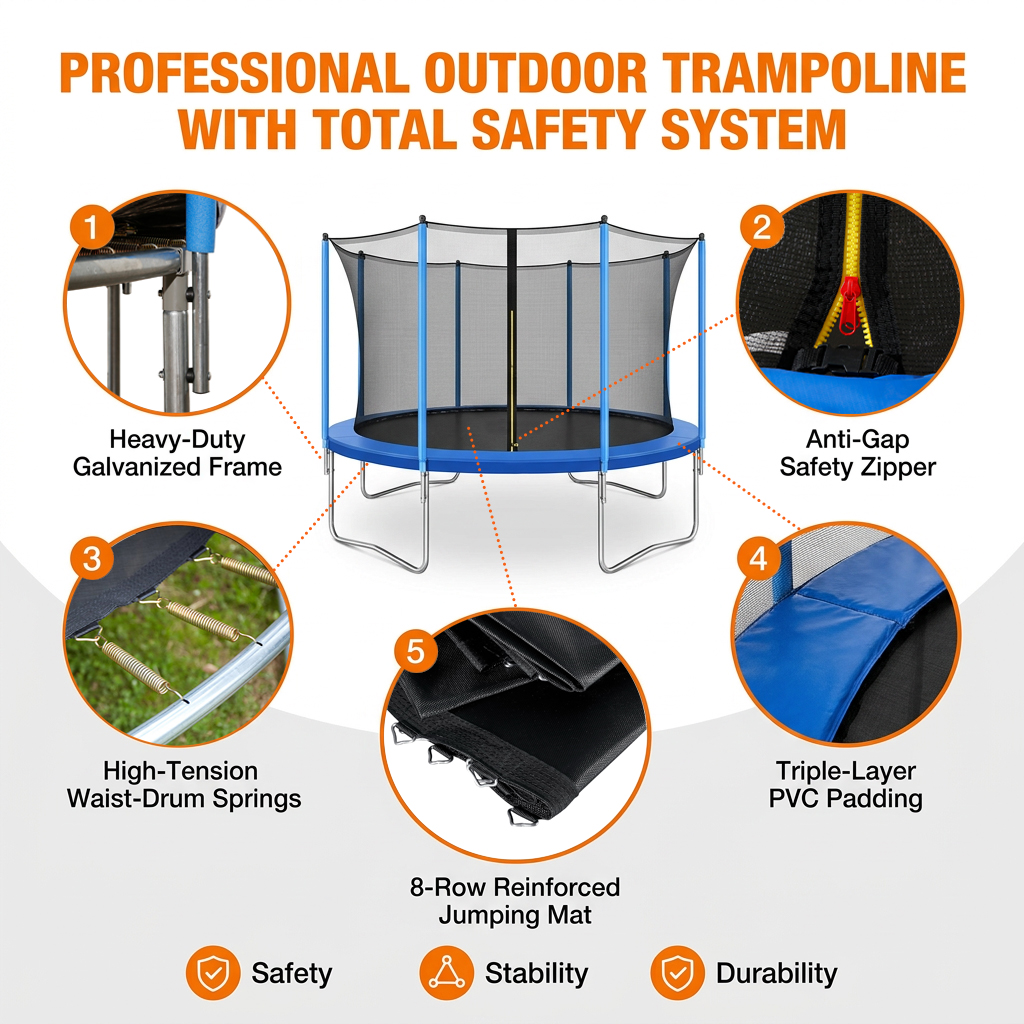
The mat edge is where the fabric meets the spring, and it is the most common single point of failure in the field. Modern beds use V-rings (also called triangle rings), small galvanized steel triangles sewn into the perimeter through which each spring hooks. The critical variable is not the ring itself but how many rows of stitching secure it. Entry-level mats use 4 rows; commercial-grade mats use 6 to 8 rows of high-tenacity polyester thread.
Each additional stitch row meaningfully raises the pull-out threshold. A 4-row construction typically holds a static pull of roughly 200–280 kg per V-ring before thread failure, while an 8-row V-ring stitching construction pushes that to 380–500 kg per ring. For park equipment subjected to repeated high-impact group jumping, the 8-row spec is the safer default. Importers should also confirm the thread is UV-resistant bonded polyester rather than standard nylon, because nylon thread rots visibly faster under direct sun and is the usual culprit behind “my mat rings pulled out” warranty claims.
Spring System Evolution: From Coil Springs to Spring-Free Structures
The conventional trampoline spring is a tapered or straight-coil steel spring with a hook at each end. Over the past fifteen years a second architecture has moved from novelty to mainstream: the spring-free or rod-based system, which replaces metal coil springs with flexible glass-fiber or composite rods fixed to the frame. From a procurement standpoint the two systems present very different cost and performance profiles.
Coil springs are cheap to manufacture, easy to replace individually, and give the familiar “boing” bounce. Spring-free systems eliminate pinch points and exposed metal at the jump surface edge, which is why they are popular in the family and preschool segments, but they cost more — component cost is typically 20–40% higher than an equivalent coil-spring build, and the rods are not field-replaceable by the end user, requiring full assembly swaps. For a private-label importer targeting price-sensitive retail, coil springs remain the rational default; for a brand differentiating on safety messaging, the spring-free premium can be recovered at retail.
Spring Length, Wire Diameter, Coil Count, and Bounce Feel
Bounce character is engineered, not accidental. Three spring parameters decide whether a trampoline feels “soft” or “hard.” Length ranges from about 14 cm (5.5 in) on compact backyard units to 21–25 cm (8–10 in) on park frames. Wire diameter typically spans 2.8–3.5 mm for residential use and 3.2–4.0 mm for heavy-duty commercial springs. Active coil count usually falls between 6 and 11 coils.
The feel rule is intuitive once stated: longer springs and thinner wire produce a softer, deeper, more forgiving bounce; shorter springs with thicker wire produce a harder, faster, higher-rebound surface. A 14 cm spring at 2.8 mm wire gives a gentle backyard feel suited to children, while a 21 cm spring at 3.5 mm wire delivers the energetic rebound park jumpers expect. Tuning these three numbers is how a supplier differentiates two seemingly identical 14 ft models, and a spec sheet should pin down all three rather than just “springs included.”
 Anti-Rust Surface Treatment: Electroplating vs Dacromet and Salt Spray
Springs live outdoors and rust is the leading cause of premature failure and the most common after-sales complaint in humid and coastal markets. Two surface treatments dominate. Electroplating (zinc plating) is the traditional, lower-cost option. Dacromet coating is a zinc-aluminum flake treatment applied without electrolysis, offering substantially better corrosion resistance and no hydrogen embrittlement risk.
The difference is quantifiable in the salt spray chamber. Electroplated springs typically show first red rust at 24–72 hours of neutral salt spray exposure (ASTM B117). Dacromet-treated springs routinely reach 500–1000 hours before red rust appears. For importers shipping to Florida, the Gulf coast, Australia, or any poolside installation, specifying a salt spray test minimum of 480 hours on springs is a reasonable procurement floor, and Dacromet is the cost-effective way to meet it. The coating also matters cosmetically: a rusty spring visible through the bed reads as a “cheap” product even when structurally sound.
Spring Count Calculation Logic: Perimeter Divided by Spacing
A frequent sourcing error is accepting a spring count without understanding how it was derived. The underlying logic is simple geometry: the number of springs equals the frame perimeter divided by the spring-to-spring spacing, adjusted for frame joints and overlap. For a round 12 ft (3.66 m) trampoline, the circumference is π × 3.66 ≈ 11.5 m. With a typical residential spacing of 5–7 cm, that yields roughly 165–230 positions, but real backyard designs use 60–96 springs because they space springs 10–16 cm apart to lower cost while keeping acceptable tension. Park frames, with stiffer requirements, often use 100–140 mm spacing around much larger perimeters, producing 120–300+ springs per unit.
The takeaway for buyers is to treat spring count as a function of two independent variables — perimeter and spacing — rather than a standalone quality number. A 15 ft model with 96 springs at 12 cm spacing is not automatically “better” than one with 72 springs at 16 cm spacing if the latter uses longer, higher-rate springs. The spec sheet should state both the count and the spacing, plus the target mat tension, so the build can be reproduced and verified.
Mat UV Aging and Service Life: The Replacement-Part Business
No mat lasts forever, and the replacement mat is one of the most reliable recurring-revenue lines in the trampoline aftermarket. UV radiation is the primary killer. In intense-sun regions such as the southwestern United States, the Middle East, and central Australia, a standard PP bed typically needs replacement every 2–4 years, while in shaded or temperate climates the same mat can last 5–7 years. Permatron-grade fabric extends that range by roughly 30–50% under equal exposure.
For distributors this aging curve is an opportunity, not just a liability. B2B buyers should plan replacement inventory against their installed base: a practical rule is to stock one replacement mat per 8–12 units sold in sunny markets, with springs stocked at roughly 5–10% of unit volume to cover individual failures. Listing mat and spring SKUs alongside the frame in the catalog, and printing the model’s fabric weight and spring dimensions on the bed label, dramatically reduces returns caused by customers ordering the wrong-size replacement. The replacement business also builds a second purchase relationship with the end retailer long after the initial container has cleared.
Tip: Always require a third-party salt spray report for coastal or poolside shipments — surface rust complaints are the No.1 after-sales issue in humid markets.
What to Specify in a B2B Procurement Spec Sheet
The single most useful improvement an importer can make is to replace vague line items like “strong mat, good springs” with measurable test requirements. A complete mat-and-spring specification should cover the following:
- Mat fabric: material (UV-stabilized PP), weight in g/m², weave density (threads/inch), and brand-equivalent grade (Permatron or equivalent).
- Mat strength: grab tensile strength per ASTM D5034 (typical 900–1400 N), tear strength, and V-ring stitch pull-out load with the stated number of stitch rows.
- Mat durability: xenon-arc or QUV accelerated weathering hours claimed (500–2000 h) and drainage rate under a defined rainfall equivalent.
- Spring geometry: free length, wire diameter, active coil count, and spring rate in N/mm for a defined deflection.
- Spring corrosion: surface treatment type and minimum neutral salt spray hours to red rust, with the test standard cited.
- Spring fatigue: cycle-life validation, commonly 50,000–100,000 full-compression cycles without permanent set beyond spec.
- System validation: maximum rated user weight and measured mat deflection under that load.
Including these items turns a purchase order into an enforceable contract. When a shipment arrives with 2.6 mm wire instead of the specified 3.2 mm, or with 4-row stitching instead of 8, the spec sheet is what lets a buyer reject the container rather than absorb the cost as future warranty claims.
FAQIs Permatron worth the upgrade over standard PP permeable cloth?
For residential private-label programs, standard UV-stabilized PP at 180–230 g/m² is usually adequate and keeps cost down. For park operators, rental fleets, and sunny-region markets, the heavier Permatron-equivalent fabric pays back through roughly 30–50% longer service life and fewer mid-season replacements.
How many stitch rows should a commercial trampoline mat have?
Residential mats commonly use 4 rows, but park-grade and high-traffic units should specify 6 to 8 rows of UV-resistant bonded polyester thread. The extra rows raise per-ring pull-out strength from around 200–280 kg into the 380–500 kg range.
Does a spring-free system last longer than coil springs?
Not necessarily longer, but it removes pinch-point injury risk and eliminates rust-prone exposed coils at the jump edge. The trade-off is 20–40% higher component cost and rods that are not individually user-replaceable, which shifts maintenance toward full assemblies.
What salt spray hour rating should I require for springs?
For general markets, 72–240 hours of neutral salt spray (ASTM B117) to first red rust is a common residential floor. For coastal, poolside, or high-humidity regions, specify Dacromet treatment with a minimum of 480 hours, and verify with a third-party report.
How do I estimate replacement mat inventory for my market?
Use climate as the driver. In intense-sun regions plan one replacement mat per 8–12 units sold and stock springs at 5–10% of unit volume. In temperate, shaded markets, one mat per 15–20 units is often sufficient.
About Us
Funjump is committed to producing safe and stable trampolines and can customize a variety of high-quality trampolines for you, including indoor and outdoor, adult and children, fitness and leisure, and so on.
Media Contact
Company Name: Zhejiang Lingsha Technology Co., Ltd.
Contact Person: Media Relations
Email: Send Email
Country: China
Website: https://www.funjumptrampoline.com/


