
Student Team Develops Hybrid Forming Method for Thin-Walled Aerospace Components
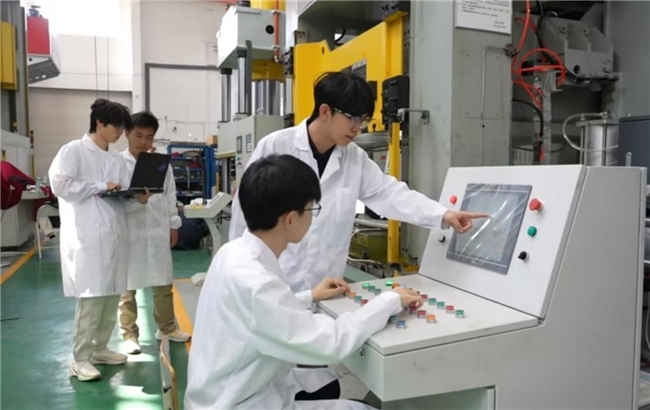
DALIAN, China – A student team led by Shi Jinhe at Dalian University of Technology has developed a gas-liquid hybrid pressure-forming method for complex thin-walled aerospace components. In validation involving air intakes used in some UAVs, the process shortened the production cycle by about 70% and cut the scrap rate from around 40% to below 5%.
A Longstanding Manufacturing Challenge
Thin-walled metal components are widely used in aircraft fuselages and wings, UAV air intakes, aero-engine air intakes and leading-edge structures. They help capture incoming air, manage airflow and reduce structural weight.
As aerospace equipment becomes lighter and more complex, these parts are becoming harder to manufacture consistently. Wrinkling, cracking and springback affect dimensional accuracy and later assembly, while repeated die trials lengthen production cycles, reduce efficiency and raise manufacturing costs. Developing a high-efficiency, low-cost forming process has therefore become a pressing industry need.
Professor He Zhubin of the School of Mechanical Engineering, the team’s faculty adviser, said complex thin-walled tubular parts have traditionally relied on hydroforming.
“High-pressure loading can provide the required forming force, but it is less flexible when dealing with local features and irregular cross-sections,” He said. “The process window is often narrow, and repeated die trials make it difficult to balance production efficiency and cost.”
Conventional hydroforming equipment also requires substantial investment, while hot gas pressure forming can involve slow filling and long production cycles. The team therefore focused on developing a high-efficiency, low-cost alternative.
How the Gas-Liquid Process Works
The Yuliu Jinggong Team began with problems identified in industrial production. Under Shi’s leadership, the students analysed component defects, dimensional requirements and equipment conditions, then converted them into process parameters and experimental plans.
Professor He said gas and liquid play different roles at different stages of forming. Gas is compressible, while liquid can transmit pressure evenly and steadily.
The gas-liquid process combines the compressibility of gas with the liquid’s ability to transmit pressure uniformly, enabling flexible regulation and stable transmission of internal pressure. This coordinated action maintains forming stability, promotes uniform material flow, and improves the component’s conformity to the die and the forming quality of complex thin-walled components.
Team member Zhao Haochen said the method changes pressure loading from a single-medium process to coordinated gas-liquid control. The students tested key variables including the gas-liquid volume ratio and initial gas pressure, adjusting the settings according to the deformation and defects observed during experiments.
From Laboratory to Industrial Validation
The students also carried out equipment adjustment, die testing and process monitoring, repeatedly comparing experimental results with their models and revising the process when the two did not match.
The method has been validated on air intakes used in some UAVs. Air intakes are demanding parts because their geometry affects both airflow and structural installation.
According to the project results, the production cycle for a single component was shortened by about 70% compared with the previous process. The scrap rate fell from around 40% to below 5%, with clear improvements in production efficiency and process stability.
The results show that the value of the process lies not only in forming a complex component, but also in reducing repeated die trials and experience-based adjustment. For aerospace parts with complex geometry and tight dimensional requirements, that level of control is important for stable batch production.
Student-Led Engineering
The project was carried out with students as the main participants. Under Shi’s leadership, team members completed process modelling, equipment adjustment, parameter testing and experimental validation, while Professor He provided academic and technical guidance.
By turning factory-floor problems into analysable models and adjustable parameters, the team connected classroom knowledge with real engineering work. As aerospace structures become lighter and more complex, the ability to manufacture them consistently is becoming as important as the design itself.
Media Contact
Company Name: Dalian Yuliu Precision Metal Forming Co., Ltd.
Contact Person: Geng Liguo
Email: Send Email
City: Dalian
Country: China
Website: https://www.dlut.edu.cn


