
Supermarkets Market to Hit USD 1.22 Trillion by 2031, Driven by Private Labels, Omnichannel Retail and Fresh Convenience, Says Mordor Intelligence
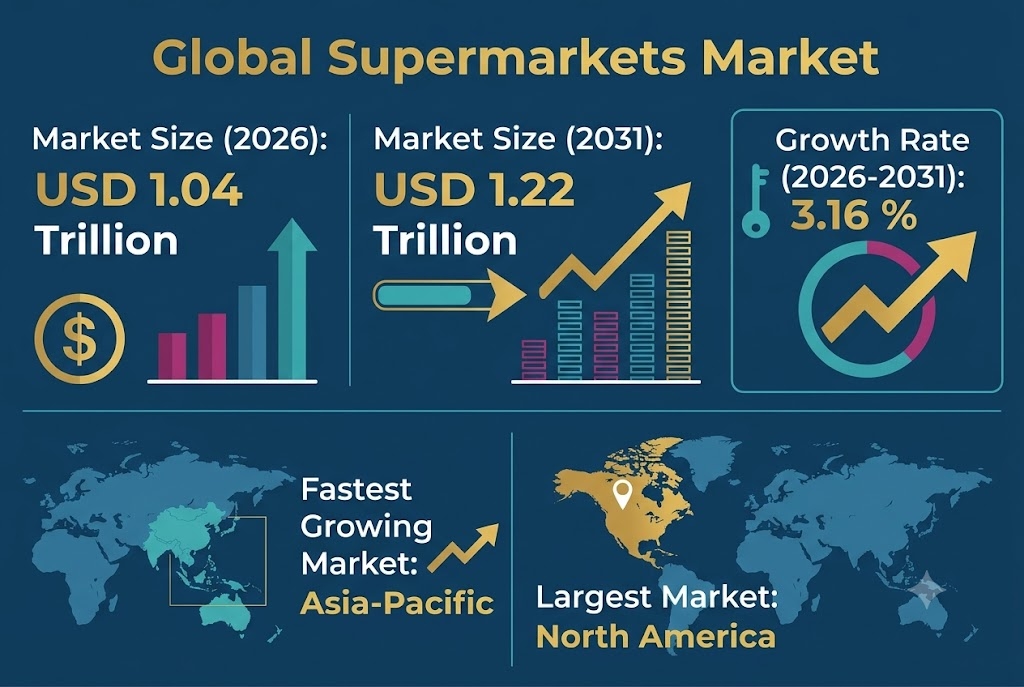
Hyderabad, India, October 28, 2026: According to Mordor Intelligence, the global supermarkets market is projected to expand from USD 1 trillion in 2025 and USD 1.04 trillion in 2026 to USD 1.22 trillion by 2031, registering a CAGR of 3.16% between 2026 and 2031. The market continues to benefit from steady grocery demand as consumers prioritize convenient shopping, broad product availability, competitive pricing, and access to fresh and packaged food through both physical stores and digital channels. Retailers are also strengthening their operating models through private-label expansion, loyalty programs, improved supply chains, and integrated online and offline shopping experiences.
The supermarkets market Size reflects the continued importance of modern grocery retail across developed and emerging economies. Large retail groups are using their procurement scale and extensive store networks to improve product availability and value for shoppers, while independent supermarkets continue to compete through local assortments, fresh products, and community-focused services. At the same time, changing shopping habits are encouraging supermarkets to connect stores, websites, mobile applications, delivery services, and pickup options into a more consistent customer journey.
Supermarkets Market Growth Drivers
Private-label expansion strengthens value positioning
Private-label products are becoming an important part of supermarket strategies as retailers seek to offer competitive prices while improving control over product margins and assortment. Store brands now cover a wider range of food, household, personal care, and everyday consumer products, allowing supermarkets to address different customer budgets and preferences.
European retailers, particularly discount-focused operators, continue to expand private-label ranges across value and premium tiers. The approach also supports stronger customer loyalty because shoppers increasingly associate retailer brands with consistent quality and competitive pricing. Private-label development is therefore expected to remain an important factor influencing supermarkets market trends as operators balance affordability with product differentiation.
Digital loyalty programs improve customer engagement
Supermarkets are increasingly using loyalty programs and mobile applications to encourage repeat purchases and provide more relevant offers. Digital loyalty platforms allow retailers to connect purchase information with promotions, rewards, online shopping, and personalized recommendations.
In mature grocery markets, these programs are becoming closely connected with digital coupons, subscriptions, pickup services, and online carts. Retailers can use these capabilities to improve customer retention while gaining better visibility into shopping patterns. The growing role of loyalty ecosystems also supports the broader Supermarkets Industry as retailers seek to increase basket value and strengthen relationships with existing customers.
AI supports inventory and shelf management
Supermarkets are applying artificial intelligence across inventory planning, product recommendations, replenishment, and store operations. These applications can help retailers identify stock gaps, improve forecasting, support employees with inventory-related tasks, and make digital shopping experiences more relevant.
Better inventory management is particularly important for supermarkets because fresh products require frequent replenishment and careful stock control. Retailers are also combining store-level information with online purchasing data to improve product availability across channels. As these capabilities become more closely integrated into everyday retail operations, technology-supported inventory management is expected to contribute to market growth while helping supermarkets control waste and improve service.
Fresh convenience and prepared foods gain importance
Consumers with busy schedules are increasing demand for convenient meal solutions, encouraging supermarkets to expand prepared foods, ready-to-eat products, bakery ranges, and fresh convenience zones. These categories provide additional reasons for customers to visit stores and can increase the number of shopping occasions.
Supermarkets are responding by developing in-store kitchens, prepared meal counters, and broader fresh assortments. The strategy allows retailers to compete not only on traditional grocery baskets but also on immediate meal needs. Fresh convenience is particularly relevant in urban markets, where consumers may prefer supermarkets that combine everyday grocery shopping with quick meal solutions.
Access This Report in Japanese: https://www.mordorintelligence.com/ja/industry-reports/global-supermarket-market?utm_source=abnewswire
Supermarkets Market Segmentation
The Supermarkets Market is segmented by product category, sales channel, ownership, and geography. The product category includes fresh food, packaged food, beverages, household products, personal care, ready-to-eat products, and other categories. Sales channels comprise offline and online formats, while ownership is divided between retail chains and independent operators.
Key segmentation areas include:
-
By product category: Fresh food, packaged food, beverages, household products, personal care, ready-to-eat, and others
-
By sales channel: Offline and online
-
By ownership: Retail chains and independent stores
-
By geography: North America, Europe, Asia-Pacific, South America, and Middle East & Africa
Packaged and processed food remains an important part of supermarket sales because of its broad assortment, shelf stability, and established distribution networks. Ready-to-eat and prepared foods are gaining attention as supermarkets respond to demand for convenient meal options. Offline stores continue to form the foundation of grocery retail, while online channels are gaining relevance through delivery, click-and-collect, and integrated loyalty services.
Retail chains benefit from procurement scale, established distribution infrastructure, and stronger investment capacity. Independent supermarkets, meanwhile, continue to serve local communities through differentiated assortments, fresh products, and personalized service.
Explore Our Full Library of Retail Research Reports: https://www.mordorintelligence.com/market-analysis/retail?utm_source=abnewswire
Geography Analysis of the Supermarkets Market
North America represents the largest regional market, supported by established supermarket networks, large-scale operators, strong grocery spending, and increasing digital adoption. Retailers in the region are investing in store modernization, fulfillment capabilities, loyalty programs, and distribution infrastructure to improve convenience and customer retention.
Europe remains an important market where private-label penetration, price competition, store modernization, and purchasing alliances continue to influence supermarket performance. Major retailers are strengthening value propositions while expanding their own-brand portfolios across different consumer segments.
Asia-Pacific is the fastest-growing regional market, supported by urbanization, expanding organized retail, rising household incomes, and increasing adoption of modern grocery formats. Retailers are expanding their presence in major cities and developing formats suited to changing household needs. The region also presents opportunities for supermarkets to combine physical stores with online ordering, delivery, and membership-based services.
South America and the Middle East & Africa continue to provide opportunities as organized grocery retail expands and retailers improve distribution, product availability, and modern shopping formats. Local market conditions, consumer preferences, and retail infrastructure remain important factors shaping regional performance.
Key players in the Supermarkets Market
The competitive landscape includes large multinational retailers, regional supermarket groups, discount operators, and independent businesses. Leading companies are competing through store networks, private-label portfolios, pricing strategies, digital services, supply-chain capabilities, and customer loyalty programs.
Major companies covered in the market include:
-
Walmart Inc.
-
Schwarz Gruppe
-
Carrefour SA
-
Aldi Süd & Nord
-
The Kroger Co.
These companies continue to strengthen their positions by improving store operations, expanding digital capabilities, enhancing private-label offerings, and investing in logistics. Competition also remains strong from regional supermarket groups that understand local consumer preferences and maintain dense store networks in their respective markets.
Market Outlook
The Supermarkets Market is expected to maintain steady growth as grocery retailers respond to changing consumer expectations around price, convenience, freshness, and shopping flexibility. Private-label expansion, digital loyalty programs, AI-supported operations, and fresh convenience offerings are becoming important areas of focus for retailers seeking to improve customer retention and operating efficiency.
The combination of established supermarket networks and expanding digital channels is creating a more integrated grocery environment. Retailers that can maintain competitive pricing while delivering reliable product availability, convenient shopping options, and differentiated assortments are positioned to strengthen their market presence. With North America maintaining its leading position and Asia-Pacific offering strong growth opportunities, the global supermarket sector is expected to remain an important part of the wider Supermarkets Industry through the forecast period.
For more insights on this market, please visit the Mordor Intelligence page: https://www.mordorintelligence.com/industry-reports/global-supermarket-market?utm_source=abnewswire
Related Reports
Omnichannel Retail Market Size: The Omnichannel Retail Market is projected to grow from USD 7.13 trillion in 2025 to USD 7.86 trillion in 2026 and reach USD 11.31 trillion by 2031, expanding at a CAGR of 7.55% during 2026–2031. Retailers are increasingly viewing unified commerce as a long-term operational investment rather than a temporary response to digital shopping trends. Investment is shifting from standalone improvements to websites, stores, or mobile apps toward integrated inventory management, unified customer profiles, and fulfillment systems that connect and support every retail touchpoint.
Get more insights: https://www.mordorintelligence.com/industry-reports/global-omnichannel-retail-market?utm_source=abnewswire
E-Retail Market Share: The E-Retail Market is segmented by product into home appliances and electronics and other products; by platform type into marketplace platforms, direct-to-consumer brand stores, and other platforms; by device into mobile, desktop and tablet, and other devices; and by geography into North America and other regions. The market forecasts are provided in terms of value (USD).
Get more insights: https://www.mordorintelligence.com/industry-reports/global-e-retail-market?utm_source=abnewswire
About Mordor Intelligence
Mordor Intelligence is a global market intelligence firm, founded in 2014, helping businesses make informed decisions through data-driven insights, industry expertise, and advanced analytics. With 550+ domain experts and on-ground specialists across 150+ countries, the company delivers comprehensive intelligence across aerospace & defense, agriculture, automation, automotive, chemicals & materials, consumer goods & services, electronics, energy & power, financial services, food & beverages, healthcare, hospitality & tourism, information & communications technology, and logistics.
Its offerings include syndicated industry reports, custom research and advisory, and subscription platforms such as Synapse, Data Center Intelligence, and Robotics Intelligence. Mordor Intelligence is ISO 9001:2015 and ISO/IEC 27001:2022 certified, a member of ESOMAR and the Market Research Society of India, and a four-time Great Place to Work® honoree. Learn more at mordorintelligence.com.
For any inquiries or to access the full report, please contact:
https://www.mordorintelligence.com
Media Contact
Company Name: Mordor Intelligence
Contact Person: Jignesh Thakkar
Email: Send Email
Phone: +1 617-765-2493
Address:11th Floor, Rajapushpa Summit, Nanakramguda Rd, Financial District, Gachibowli [email protected]
City: Hyderabad
State: Telangana 500008
Country: India
Website: https://www.mordorintelligence.com/


