
Chinese Manufacturers Reveal Breakthrough Commercial UAV Technologies for Global Markets
Sheridan, Wyoming, USA – October 27, 2026 – You know, China’s become a huge player in commercial drones—they’re used for everything from surveying and farming to construction, logistics, and even emergency response. The manufacturers over there pack together compact airframes, gimbaled cameras, smart software, and a solid service network. But here’s the thing: picking the right drone isn’t just about comparing flight times or camera megapixels. There’s a lot more to it than that.Frank Wang, the guy who started DJI, basically hits the nail on the head when he says, “The drone is a platform, and it can be used for many different things.” And honestly, that idea still holds up. Here’s the thing though: a commercial UAV needs to actually fit into how you work, not just look good on paper with a bunch of flashy specs. Take a look at DJI, XAG, Autel Robotics, JOUAV, and EHang—they each bring something different to the table, whether it’s top-notch imaging, precision ag, long-endurance inspections, or even pushing into urban air mobility. But don’t go thinking you can just swap one for another, because that’s not how it works. Different tools for different jobs, right?Look, you can talk about specs and marketing all day, but the real evaluation happens on site. Can that thing hold its position right next to a 120-meter bridge? Can its camera actually spot a cracked insulator at dawn, when the light’s tricky? And what about swapping batteries in the rain and dust—do technicians have to wrestle with it? These are the details that matter way more than the shiny brochures. Plus, you’ve got to think about data security, pilot training, maintenance support, export controls, and local rules—those can be deal-breakers. So at the end of the day, the best choice isn’t always the newest model.Look, some of these solutions are pricey – like, really pricey. And then others, they just don’t play nice with your existing software unless you invest in some serious integration work. Battery life is still a big sticking point, especially when you’re out there doing inspections in freezing temperatures – that’s when the range just tanks. So, from my perspective, you really need to put these things through their paces before you sign anything. Have the vendor demo actual missions, not just a scripted show. Independent tests, real performance data, and transparent support terms? That’s what actually counts, not all the marketing fluff. This guide takes a look at some of the leading commercial UAV solutions coming out of China. But I do want to flag one thing though: product availability and compliance requirements aren’t set in stone—they can vary by region and shift over time. So just keep that in the back of your mind while you’re reading.
 China’s Civil UAV Base: 1.26 Million Registered Aircraft in 2023
China’s civil UAV sector reached 1.26 million registered aircraft in 2023. This figure shows remarkable scale, but it needs careful interpretation. Registered does not mean airborne every day. Some aircraft remain in storage, training fleets, or seasonal operations. Still, the number reflects a broad manufacturing and service ecosystem. Commercial buyers can find solutions for mapping, crop monitoring, infrastructure inspection, delivery support, and emergency assessment. The best option depends on the task, not the aircraft’s advertised range.For land surveying, a compact aircraft with a high-resolution camera can trace roads, slopes, and construction progress. Agricultural teams may need multispectral imaging, controlled spraying, and simple reporting tools. Inspection crews often value stable hovering, obstacle awareness, spare batteries, and clear maintenance records. In remote areas, replaceable parts and trained technicians matter more than impressive specifications. A short demonstration flight can reveal problems that a brochure hides. Small details matter.Buyers should check registration status, operator qualifications, local flight permissions, insurance, and data-handling procedures before deployment. They should also confirm performance in wind, heat, rain, and weak network conditions. The 2023 total supports confidence in China’s civil UAV capacity, yet it does not remove procurement risk. Software integration can be difficult. Training may be underestimated. Battery logistics can delay a project. Independent testing and documented maintenance help expose weaknesses before a full fleet is ordered.
What Are the Best Commercial UAV Solutions from China? – China’s Civil UAV Base: 1.26 Million Registered Aircraft in 2023Commercial UAV solution areas, market indicators and operational considerations based on publicly reported Chinese civil aviation data.
| Solution Area | Primary Commercial Function | Key 2023 Data Point or Requirement | Typical UAV Configuration | Commercial Value | Reference or Regulatory Context |
|---|---|---|---|---|---|
| National Civil UAV Market | Large-scale deployment of unmanned aircraft for commercial, public-service and industrial operations. | Approximately 1.26 million registered civil UAVs in China in 2023. | Multi-rotor, fixed-wing, hybrid VTOL and specialized unmanned aircraft. | Indicates a mature registration base and substantial demand for fleet management, maintenance, training and data services. | Publicly reported 2023 data from the Civil Aviation Administration of China (CAAC); rounded figure. |
| Civil UAV Flight Operations | Routine aerial work, inspection, mapping, agriculture, logistics and emergency response. | About 23.11 million civil UAV flight hours were reported in China during 2023. | Mission-specific aircraft equipped with optical, thermal, multispectral or delivery payloads. | Shows significant real-world utilization beyond aircraft registration alone. | CAAC 2023 civil aviation industry information; flight-hour totals may include multiple commercial application categories. |
| Civil UAV Industry Output | Manufacturing, payload integration, software, data processing, training and operational services. | China’s civil UAV industry output was reported at more than RMB 117 billion in 2023. | Integrated hardware-and-software platforms with cloud-based fleet and mission management. | Supports a broad commercial ecosystem rather than a hardware-only market. | Public 2023 CAAC industry figures; the amount is stated as a rounded national estimate. |
| Precision Agriculture | Crop monitoring, multispectral imaging, targeted spraying and field surveying. | China’s agricultural UAV operations are regulated as civil aviation activities and require compliance with applicable operating, pilot and airspace rules. | Multi-rotor aircraft for spraying or spreading; fixed-wing and VTOL aircraft for large-area sensing. | Reduces manual field coverage time and enables variable-rate treatment based on crop conditions. | Operational requirements are governed by CAAC rules together with relevant agricultural and local regulations. |
| Power-Line and Energy Inspection | Inspection of transmission lines, substations, wind farms, solar facilities and industrial assets. | Commercial missions commonly require documented flight plans, risk controls, inspection records and secure image or sensor data. | Long-endurance fixed-wing or VTOL aircraft for corridors; multi-rotor aircraft for close visual inspection. | Improves inspection frequency, limits exposure to hazardous locations and creates repeatable asset records. | Requirements depend on airspace classification, site restrictions, operator qualifications and customer safety procedures. |
| Surveying and Mapping | Topographic mapping, construction progress monitoring, mining surveys and 3D modeling. | High-accuracy projects may require ground control, calibrated sensors, quality checks and compliance with surveying and geographic-information rules. | Fixed-wing or VTOL aircraft for large areas; multi-rotor aircraft for confined or complex sites. | Shortens data-collection cycles and provides measurable orthomosaics, point clouds and terrain models. | Projects may be subject to CAAC operating rules and national requirements for surveying, mapping and geospatial data. |
| Logistics and Delivery | Transport of parcels, medical supplies, industrial components and food between defined points. | Operations require route authorization, delivery-site controls, payload management, contingency procedures and reliable command links. | Multi-rotor aircraft for short-range point-to-point delivery; larger VTOL or fixed-wing systems for longer routes. | Can improve service access in remote or difficult terrain and support time-sensitive deliveries. | Commercial delivery operations are subject to applicable CAAC approvals, airspace management and local implementation rules. |
| Emergency Response | Disaster assessment, search support, flood monitoring, fire reconnaissance and communications relay. | Emergency missions prioritize rapid deployment, redundant communications, thermal sensing and operation in restricted or changing environments. | Multi-rotor aircraft for hovering and close inspection; tethered or hybrid systems for extended observation. | Provides rapid situational awareness while reducing the need to expose personnel to unstable areas. | Mission authorization and coordination with emergency, public-security and airspace-management authorities may be required. |
| Fleet and Data Management | Registration support, remote identification, maintenance records, pilot scheduling, mission logging and data security. | The large national registered-aircraft base creates demand for standardized digital records and operational traceability. | Cloud-connected control software integrated with aircraft, payloads, maintenance systems and geographic data. | Improves utilization, compliance reporting, preventive maintenance and repeatability across multi-aircraft fleets. | Systems should support applicable CAAC registration, operational reporting, electronic identification and data-protection requirements. |
| Core Selection Criteria | Evaluation of a commercial UAV solution before procurement or outsourcing. | Key indicators include endurance, payload capacity, positional accuracy, communications resilience, weather tolerance, serviceability and regulatory readiness. | Configuration should be selected according to mission area, flight environment, payload and required data output. | Combines aircraft performance with software, training, maintenance, compliance and after-sales support. | Actual performance should be verified through documented specifications, field trials, operational records and local approval requirements. |
Source note: National figures are rounded summaries of publicly reported 2023 information from the Civil Aviation Administration of China (CAAC). Application descriptions are general commercial-use categories; actual authorization, airspace, data, pilot and safety requirements vary by mission and location.Platform Types: Multirotors, Fixed-Wing UAVs, VTOL Hybrids, and Drones-in-a-Box
China’s commercial UAV market is shifting from isolated aircraft sales toward complete operating systems. The Civil Aviation Administration of China reported more than 1.26 million registered civil drones in 2023. It also recorded over 23 million flight hours. These figures suggest strong field experience, but registration alone does not prove reliable performance.Multirotors suit inspection, mapping, and emergency response. They can hover beside a bridge joint or power-line connector, then land within a small site. Their limitation is endurance, usually measured in tens of minutes. Fixed-wing UAVs cover larger agricultural and surveying areas with lower energy consumption. They need launch space and cannot hover. VTOL hybrids reduce that weakness by taking off vertically, then cruising like fixed-wing aircraft. The transition phase remains a practical failure point. It deserves more testing.Drones-in-a-box systems support scheduled inspections with limited human presence. A dock can recharge, protect equipment, and send flight data to a control center. Drone Industry Insights’ Commercial Drone Market Report 2024 projects the global commercial drone market to grow from about 30.6 billion dollars in 2023 to 57.8 billion dollars by 2028. That growth may encourage rushed purchases. Buyers should compare wind tolerance, battery aging, payload stability, data security, and maintenance records. A perfect specification sheet is not enough. Weather is less cooperative.
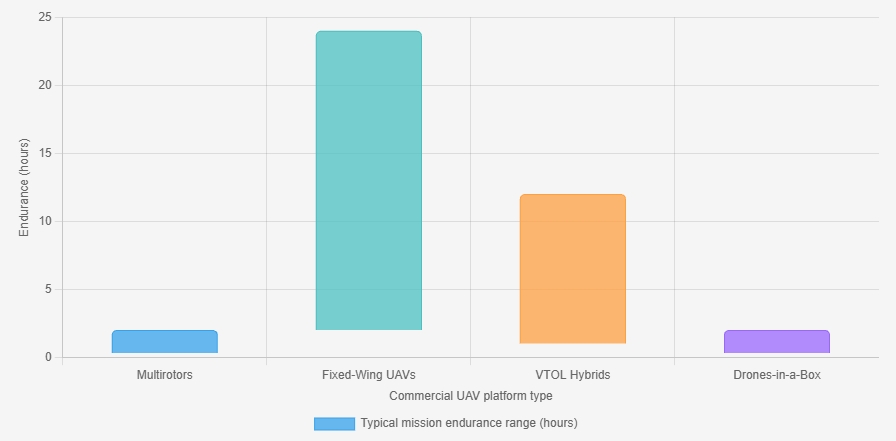
Typical Endurance Bands of Commercial UAV Platform Types
Fixed-wing UAVs generally provide the longest flight endurance, while multirotors prioritize vertical takeoff, hovering, and precise low-altitude operations. VTOL hybrids combine runway-independent deployment with longer cruise capability. Drones-in-a-box systems typically use docked multirotors, so their endurance is usually comparable to that platform type. Ranges are broad industry-typical estimates and vary with payload, battery, weather, and mission configuration.
Commercial Performance: Payload, Endurance, Range, and BVLOS Capability
Commercial UAV solutions from China are increasingly judged by usable performance, not camera resolution. Multirotors typically carry 2–8 kilograms, fly for 35–60 minutes, and cover roughly 5–15 kilometers. Hybrid fixed-wing aircraft can carry 1–5 kilograms for two to eight hours, with ranges above 100 kilometers. These figures come from published technical specifications and align with categories discussed in Drone Industry Insights’ Drone Market Report 2024.
Payload changes everything. A thermal camera, gimbal, spare battery, and safety equipment can reduce endurance quickly. Field experience often shows a 20–30% performance loss in wind, cold weather, or repeated hovering. That gap matters. A 50-minute laboratory flight may become 35 minutes above a construction site.
Small details matter.
BVLOS capability requires more than long-range radio links. It depends on redundant navigation, remote identification, detect-and-avoid functions, command-link reliability, and trained operators. The European Union Aviation Safety Agency’s Annual Safety Review 2024 continues to emphasize operational risk management for complex drone missions. Meanwhile, China’s Civil Aviation Administration reported sustained growth in registered civil unmanned aircraft and operating hours, showing wider commercial adoption. Still, range claims can be optimistic. Buyers should request independent endurance tests, wind limits, payload curves, and documented link-loss behavior before deployment.
Top Solutions by Use Case: Mapping, Inspection, Agriculture, Logistics, and SecurityWhat Are the Best Commercial UAV Solutions from China?
China’s commercial UAV sector now serves mapping, inspection, agriculture, logistics, and security. Drone Industry Insights’ 2024 market report valued the global commercial drone market at about US$30.6 billion in 2023. Chinese systems are competitive because they combine accurate positioning, thermal cameras, automation, and local manufacturing.
For mapping, multi-rotor and fixed-wing UAVs produce high-resolution terrain models, even across mines and construction sites. Inspection teams use thermal and zoom sensors to identify damaged solar panels, bridges, and power lines.
Agriculture platforms support crop scouting, multispectral imaging, and controlled spraying. The Food and Agriculture Organization reports that digital agriculture can improve resource efficiency, but results depend heavily on training and field conditions.
Logistics UAVs suit medical supplies and remote industrial routes, although payload limits remain practical obstacles. Security teams may use long-endurance aircraft for perimeter observation, with human review required for reliable decisions.
Tips: Match the aircraft to the site, not the brochure. Test battery life in wind. Check data storage, maintenance support, and operator training before purchase. The International Energy Agency notes that solar capacity continues expanding rapidly, increasing demand for inspection tools. Yet automated alerts still produce false positives. That is an inconvenient weakness. A small pilot project, measured against manual inspection time and error rates, offers more reliable evidence than impressive demonstrations.
Regulatory Fit: CAAC Remote-Pilot Rules, UAS Categories, and Airspace Access
The best commercial UAV solutions from China are not defined by payload alone. Regulatory fit matters more. Before selecting a platform, confirm its maximum takeoff weight, operating purpose, and control features. These details determine its UAS category under China’s civil aviation framework.
CAAC rules require many commercial operators to complete real-name registration, maintain operational records, and use qualified remote pilots where applicable. Small, medium, and large aircraft usually demand stronger pilot competence and stricter management. Light aircraft may have simpler requirements, but “simple” does not mean unrestricted. Airspace access also depends on location. Urban areas, airports, military zones, and temporary control areas may require approval through official channels. Local implementation can vary.
Tips: Ask the supplier for current compliance documents, not marketing claims. Check registration status, remote-pilot qualification needs, insurance expectations, and data-management functions. Test geofencing and return-to-home behavior in a controlled site. Keep a printed emergency procedure nearby. It helps.
In practical evaluations, teams often focus on endurance and camera quality first. That approach can fail. A capable aircraft is useless if the planned route cannot receive clearance. Regulations also change, and online summaries may become outdated. Confirm requirements with CAAC resources and the relevant local aviation authority before deployment. A careful compliance review should happen before the purchase order.
Economic Evaluation: Acquisition Cost, Operating Cost, and Return on Investment
For commercial UAV buyers, acquisition price is only the visible cost. A Chinese-made inspection platform may cost less than comparable imported equipment, but batteries, payloads, software, training, insurance, and maintenance quickly change the calculation. The International Trade Administration reported strong growth in China’s civil drone industry, while China’s Civil Aviation Administration recorded more than 1.2 million registered civil unmanned aircraft in 2023. Scale can support competitive pricing, yet fleet quality still varies. Cheap hardware is not automatically economical.
Operating cost depends on mission design. Energy use is usually modest, but labor remains significant. A two-person inspection team may spend hours planning routes, reviewing images, and documenting defects. The Drone Industry Insights Commercial Drone Market Report estimates that services generate a major share of industry value, reflecting this hidden labor. Buyers should calculate total cost of ownership over three to five years, including battery replacement and software subscriptions. A practical ROI formula is annual savings or revenue minus annual operating costs, divided by acquisition cost. In my experience, inspection fleets often need 12 to 24 months to recover investment, but utilization assumptions can be too optimistic.
Tips: Request a 30-day field trial. Measure productive flight hours, not total flight time. Compare repair turnaround and spare-part availability. Test data-export options before signing. One overlooked issue is workflow integration. If analysts still process imagery manually, the promised return may shrink. Add a contingency budget of 10% to 15%; real projects rarely follow the spreadsheet perfectly.
Sources: CAAC Civil Aviation Industry Development Statistical Bulletin 2023; Drone Industry Insights, Commercial Drone Market Report 2024; International Trade Administration, China Commercial Drone Market Overview.
MMC M12 Professional Drone for Long-Range Commercial Use: Insights from Drone Industry Insights 2024 Report
MMC M12 Professional Drone for Long-Range Commercial Use
The latest 2024 analysis of the commercial drone industry highlights a growing demand for aircraft that can combine extended range, operational flexibility, and lower mission costs. In this context, the M12-class professional drone represents a new generation of VTOL fixed-wing platforms designed for long-range commercial work. Its vertical takeoff and landing capability reduces dependence on runways or specialized launch equipment, while the fixed-wing configuration supports efficient forward flight over large areas. This combination enables operators to move smoothly between confined takeoff zones and sustained survey missions.Built around practical efficiency, the platform can support applications such as infrastructure inspection, environmental mapping, agricultural observation, emergency assessment, and remote asset monitoring. Its value lies not only in flight endurance, but also in reducing deployment complexity and improving coverage per mission. A professional payload architecture allows the aircraft to accommodate different imaging or sensing tools according to project requirements, while automated flight planning can help maintain consistent data collection. By integrating the accessibility of multirotor aircraft with the endurance advantages of fixed-wing designs, this VTOL platform redefines the efficiency limits of commercial drone operations and offers a scalable solution for organizations managing demanding, long-distance missions.
Conclusion
China’s commercial UAV sector has developed into a large and diverse civil aviation ecosystem, with approximately 1.26 million registered aircraft in 2023. Commercial Uav Solutions now include multirotors for precise, low-altitude work; fixed-wing aircraft for efficient long-distance coverage; VTOL hybrids for flexible takeoff and extended missions; and drones-in-a-box systems for automated, repeatable operations. Their value is measured through payload capacity, flight endurance, operating range, data quality, and the ability to support safe beyond-visual-line-of-sight missions where authorized.The most suitable platform depends on the application. Mapping requires stability and accurate data collection, while inspection emphasizes imaging, reliability, and access to difficult infrastructure. Agriculture benefits from efficient field coverage, logistics focuses on payload and route efficiency, and security uses persistent monitoring and rapid deployment. Buyers should also assess compliance with CAAC remote-pilot requirements, UAS classifications, operator qualifications, and airspace access procedures. A complete economic evaluation should compare acquisition, training, maintenance, insurance, energy, and labor costs against productivity gains, risk reduction, and long-term return on investment.
About Us
We turn drones from tools into infrastructure, enabling the global low-altitude economy with engineering rigor and compliance.To become the core infrastructure provider for the global low-altitude economy. We will keep integrating 5G, AI and hydrogen energy to drive standardized, intelligent and green aerial operations.
Media Contact
Company Name: UUUFLY AeroTech Corp.
Contact Person: Media Relations
Email: Send Email
Country: China
Website: https://www.viscolift.com/


