
Global Buyers Identify Top Decorative Cover Suppliers for Industry Expansion
Chaozhou, Guangdong, China – October 22, 2026
Picking the right Decorative Cover supplier? Honestly, it can make or break a product’s first impression, how long it lasts, and whether it sells well. Lots of global buyers start by comparing factory prices—but price alone tells you almost nothing. A supplier you can trust should be able to show you material samples, color standards, production photos, and a clear quality process. Those things really matter when a cover has to survive shipping, being handled over and over, humidity, or sitting on a retail shelf.Debbie Millman, who knows a thing or two about packaging and brand design, calls packaging “a brand’s most tangible and tactile touchpoint.” That’s a good way to see why sourcing Decorative Cover isn’t just about nice artwork. You’ll want to look at board thickness, coating adhesion, print registration, corner finishing, and surface resistance. Also ask about MOQs, sampling fees, lead times, and export paperwork. Good communication helps, sure—but it doesn’t replace actual testing.The best suppliers tend to mix manufacturing experience with technical support that actually responds. Some can send digital samples fast. Others hold color consistency better once mass production starts. Very few are great at everything. Worth keeping in mind. A gorgeous prototype can still fail when it’s folded, stacked, or shipped halfway around the world. So global buyers should ask for a pre-production sample and set acceptance standards before committing to a big order.This guide walks through leading Decorative Cover suppliers for international purchasing teams. It looks at product range, customization, production capacity, quality control, communication, and delivery reliability. Company claims? They deserve checking. Factory audits, independent inspections, and reference calls are still worth the effort. No ranking can wipe out every sourcing risk. But careful comparison can help you avoid expensive surprises and make a more dependable supplier decision.
 Defining Decorative Covers: Materials, Uses, and Global Product Categories
A decorative cover is an outer layer that improves appearance, protects a surface, or both. In sourcing work, I have seen buyers confuse covers with permanent components. That mistake affects pricing, packaging, and product testing. Common materials include cotton, polyester, linen blends, vinyl, silicone, and coated paper. Each creates a different hand feel. Polyester resists wrinkles, while cotton feels warmer and more breathable. Vinyl wipes clean, but it can feel stiff under bright showroom lights. Material choice should follow the object, climate, cleaning method, and expected handling.Uses range from chair cushions and appliance Sleeves to gift boxes, storage baskets, and outdoor furniture shields. Some covers are soft and removable. Others use molded shells or printed laminates. Global catalogs often group them as textile covers, protective covers, packaging covers, seasonal décor, and custom-fit accessories. A useful product sheet should state dimensions, closure type, edge finish, weight, color method, and care instructions. Photos alone are not enough. A sample reveals loose stitching, uneven coating, or an unpleasant odor.For global buyers, supplier reliability matters as much as visual design. Ask for material specifications, production samples, inspection records, and clear tolerance ranges. Check whether packaging protects corners during long-distance handling. A Cheap Decorative Cover may look attractive online, yet thin fabric can tear after repeated removal. That is where judgment becomes difficult. Low cost is not always poor value, but the cheapest option may create replacement waste. I would also question color consistency across batches, especially for large hospitality or retail projects. Small details matter.
Decorative Cover Materials: Typical Thickness by Product Category
Decorative covers are commonly produced as films, laminated papers, flexible PVC sheets, and synthetic leather. The chart shows representative commercial thickness midpoints used across common global applications; actual specifications vary by supplier and end use.
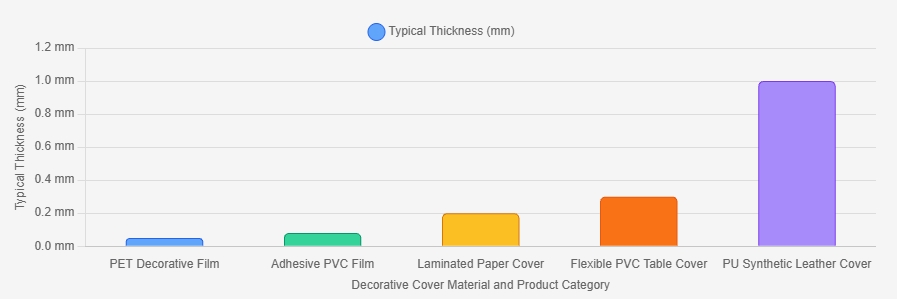
Typical reference ranges: PET decorative film 0.03–0.07 mm; adhesive PVC film 0.06–0.10 mm; laminated paper cover 0.15–0.25 mm; flexible PVC table cover 0.20–0.40 mm; PU synthetic leather cover 0.80–1.20 mm.
Top Decorative Cover Suppliers for Global Buyers?Global demand for decorative textile covers is tied to wider home-furnishing trade. The WTO reported approximately US$339 billion in global textile exports in 2022, excluding clothing. ITC Trade Map data for HS 6304 helps buyers compare furnishing-article imports, supplier countries, and seasonal demand. These figures reveal opportunity, but classification can be inconsistent. A cover may be recorded differently across customs systems.European buyers often request verified fiber content, colorfastness, traceable materials, and chemical compliance documents. They also examine seam density and shrinkage after repeated washing. North American importers commonly focus on packaging efficiency, delivery reliability, and performance testing. Buyers in the Middle East and Asia may prefer richer textures, larger dimensions, and stronger decorative appeal. Regional taste is not fixed.Practical sourcing requires more than comparing quotations. A low unit price can be a false victory. Sample covers should be checked under daylight, not only showroom lighting. Test zipper strength, edge stitching, abrasion resistance, and dimensional change. The European Environment Agency has highlighted textile waste and durability concerns, while circular-design policies are increasing documentation pressure. Suppliers that provide test reports, production photos, and batch records are easier to audit. Yet reports can become outdated, and small workshops may lack formal systems. That weakness deserves honest evaluation, not automatic rejection.
Top Decorative Cover Suppliers for Global Buyers? – Mapping Global Demand: Textile Trade Data and Regional Buyer Requirements
Regional sourcing guide for decorative textile covers, protective covers, awnings, sunblinds, tents and related made-up textile articles. Trade classification references are based on the Harmonized System (HS).
| Buyer Region | Relevant HS Trade Categories | Typical Demand Profile | Preferred Material and Construction | Key Buyer Requirements | Documentation and Testing | Supplier Evaluation Priorities |
|---|---|---|---|---|---|---|
| European UnionGermany, France, Italy, Spain, the Netherlands and Poland | HS 6304 Other furnishing articlesHS 6306 Tarpaulins, awnings, sunblinds, tents and other camping goods | Interior decorative covers, outdoor furniture covers, balcony and patio shading, seasonal hospitality projects, and made-to-measure home-textile articles. | Recycled or conventional polyester, cotton blends, solution-dyed synthetic fabric, UV-resistant coatings, water-repellent finishes and concealed fastening systems. | Clear fibre-composition information, restricted-substance control, colourfastness, dimensional stability, low-emission finishes, repairability and consistent batch colour. | Regulation (EU) No 1007/2011 for textile fibre names and labelling; REACH Regulation (EC) No 1907/2006 for chemicals; GPSR compliance where applicable; test reports for colourfastness, shrinkage and coating performance. | Traceable raw materials, documented chemical management, recycled-content evidence when claimed, accurate technical files, low minimum order quantities and reliable delivery to multiple European destinations. |
| United KingdomEngland, Scotland, Wales and Northern Ireland | HS 6304 Textile furnishing articlesHS 6306 Awnings, sunblinds, tents and protective textile covers | Garden furniture covers, window and patio shading, hospitality refurbishment, rental-property furnishings and decorative protective covers for seasonal use. | Polyester, acrylic-type outdoor fabrics, cotton-linen appearances, coated woven fabric and fabrics with mould, water and UV resistance. | Accurate fibre labels, care instructions, dependable colour matching, water resistance, practical packaging and compatibility with UK plug-free manual or motorised shade systems where relevant. | Textile Products (Labelling and Fibre Composition) Regulations 2012; UK REACH requirements; product safety documentation; care and performance test records requested by the buyer. | Flexible production, short replenishment lead times, export-ready packaging, clear incoterms, stable quality after repeated cleaning and the ability to supply custom dimensions. |
| United States and CanadaNorth American residential, commercial and hospitality markets | HS 6304 Other furnishing articlesHS 6306 Tarpaulins, awnings, sunblinds and tents | Outdoor living products, pool and patio covers, seasonal furniture protection, event structures, hospitality textiles and decorative covers for contract interiors. | Solution-dyed polyester, acrylic outdoor fabric, heavy-duty woven fabric, laminated fabric, mildew-resistant finishes and reinforced seams at stress points. | High tear strength, colour retention under sunlight, water resistance, mildew resistance, reinforced hems, stainless or corrosion-resistant hardware and packaging suitable for parcel or pallet distribution. | FTC Textile Fiber Products Identification Act and Care Labeling Rule where applicable; U.S. flammability requirements where the product falls within their scope; Canada Textile Labelling Act and Textile Labelling and Advertising Regulations. | ANSI/AATCC or ASTM-based test methods accepted by the buyer, stable performance across large production lots, North American sizing conventions, barcode-ready packaging and dependable container or parcel-loading plans. |
| Japan and South KoreaHigh-specification consumer and commercial markets | HS 6304 Furnishing articlesHS 6306 Awnings, sunblinds, tents and made-up outdoor textile articles | Compact residential spaces, premium interior decoration, balcony shading, retail display covers, hospitality projects and carefully finished custom products. | Fine woven polyester, cotton or linen blends, lightweight coated fabrics, anti-static finishes, neat edge binding and compact foldable constructions. | Precise dimensions, clean stitching, low odour, smooth surfaces, understated colours, compact packaging, clear washing instructions and high consistency between samples and bulk production. | Fibre-content and care information required by the destination market; chemical and performance test reports are commonly requested for imported textile goods; product-specific safety documentation may apply. | Sample approval discipline, strict inspection records, Japanese or Korean language labelling when requested, low defect rates, premium finishing and punctual shipment performance. |
| Australia and New ZealandStrong outdoor-use and high-UV markets | HS 6304 Other textile furnishing articlesHS 6306 Awnings, sunblinds, tents and protective covers | Patio and barbecue covers, caravan and marine-related covers, outdoor hospitality, poolside applications, resort furnishings and sun-protection products. | Solution-dyed polyester or acrylic-type fabric, UV-stabilised yarns, water-shedding finishes, breathable constructions and corrosion-resistant fasteners. | Strong UV durability, resistance to heat and moisture, mould control, breathable protection against condensation, reinforced corners and performance suited to coastal environments. | Product-specific Australian or New Zealand standards may apply; buyers commonly request UV, tensile, tear, water-resistance and colourfastness test results, together with fibre and care information. | Evidence of outdoor durability, packaging resistant to long-distance transport, accurate custom measurements, dependable warranty support and materials suitable for high sunlight exposure. |
| Gulf Cooperation CouncilSaudi Arabia, United Arab Emirates, Qatar, Kuwait, Bahrain and Oman | HS 6304 Furnishing articlesHS 6306 Awnings, sunblinds, tents and outdoor textile structures | Hotel and resort projects, shaded outdoor seating, majlis and event decoration, villas, retail fit-outs and large-scale temporary structures. | Heavy-duty polyester, acrylic-type outdoor textiles, PVC-coated fabric where appropriate, UV-resistant finishes, dust-resistant surfaces and reinforced industrial sewing. | Heat and UV resistance, low water absorption, dust tolerance, easy cleaning, strong seams, colour stability, fire-performance documentation for commercial projects and large custom dimensions. | Destination-specific conformity and customs documents; commercial projects may request flame-retardancy, tensile, tear, hydrostatic-pressure and UV-aging reports. | Engineering drawings, project coordination, large-format cutting and welding capability where required, fire-test traceability, strong packing methods and experience with consolidated or project cargo. |
| Southeast AsiaSingapore, Malaysia, Thailand, Indonesia, Vietnam and the Philippines | HS 6304 Textile furnishing articlesHS 6306 Tarpaulins, awnings, sunblinds, tents and camping goods | Tropical outdoor furniture, resort and restaurant decoration, rain protection, apartment balconies, event rentals and compact urban living products. | Breathable polyester, quick-dry fabrics, water-repellent woven textiles, mildew-resistant finishes, mesh panels and corrosion-resistant accessories. | Resistance to high humidity, heavy rain, mould and salt air; fast drying; washable surfaces; secure tie-down points and designs that reduce condensation. | Import documentation varies by destination; buyers commonly require fibre information, chemical declarations, colourfastness, water-repellency, mould-resistance and seam-strength test results. | Tropical-climate testing, compact shipping volume, mixed-SKU consolidation, fast sampling, flexible order quantities and consistent material availability during peak project periods. |
| Latin AmericaMexico, Brazil, Chile, Colombia, Peru and Argentina | HS 6304 Other furnishing articlesHS 6306 Awnings, sunblinds, tents and protective textile goods | Residential outdoor living, hospitality projects, commercial shading, event decoration, replacement covers and value-focused furnishing programmes. | Polyester, cotton-polyester blends, coated synthetic fabric, UV-resistant outdoor textiles and reinforced hems designed for repeated installation. | Competitive total cost, durable colour, water resistance, easy maintenance, practical repairability, Spanish or Portuguese documentation where requested and flexible custom sizing. | Destination-specific labelling and customs requirements; buyers may request fibre composition, care instructions, country-of-origin information and performance tests for outdoor applications. | Cost-efficient production, mixed-container planning, reliable documentation, regional distributor support, replacement-part availability and tolerance for varied climate conditions. |
| Sub-Saharan AfricaSouth Africa, Kenya, Nigeria, Ghana and regional hospitality markets | HS 6304 Furnishing articlesHS 6306 Awnings, tents, tarpaulins and other protective textile articles | Hospitality and safari lodges, outdoor dining, market and event structures, residential shade, transport-related protection and durable replacement covers. | Heavy woven polyester, acrylic-type outdoor fabric, coated textiles, high-strength webbing, reinforced corners and repairable modular designs. | High abrasion resistance, UV stability, dust tolerance, easy cleaning, strong attachment points, repairability and reliable performance where electricity or mechanical maintenance is limited. | Import requirements vary by country; commercial buyers commonly request origin, fibre, care, fire-performance and physical-strength documentation for project applications. | Robust construction, spare-material availability, clear installation instructions, export packaging, long service life and the ability to supply replacement panels or components. |
Trade and regulatory reference: HS headings and subheadings referenced above are drawn from the World Customs Organization Harmonized System structure, including HS 6304 and HS 6306. Import and export values should be verified for the selected year, reporter, partner and HS revision through UN Comtrade or ITC Trade Map. Regulatory references include EU Regulation No 1007/2011, EU REACH, U.S. FTC textile rules and Canada textile labelling guidance. Regional demand descriptions are buyer-oriented market requirements and should be validated against the final product specification, destination-country rules and contract conditions.Comparing Supplier Capabilities: MOQ, Capacity, Lead Times, and Certifications
Top Decorative Cover Suppliers for Global BuyersGlobal buyers should compare more than photos and attractive unit prices. A China Decorative Cover supplier may quote a low MOQ, yet restrict colors or surface finishes. Standard designs often begin at 500 pieces per style. Custom molds may require 2,000 pieces or more. Ask whether the MOQ applies per design, color, or shipment. This detail can change the real purchasing cost. Small details matter.Capacity should match your launch schedule, not only your annual forecast. A reliable supplier should explain monthly output, machine availability, and subcontracting practices. For example, 12,000 covers per month sounds useful until several orders share the same production line. Request recent production records and a sample packing list. A factory visit, live video inspection, or batch photographs can reveal workflow gaps. Capacity claims need evidence.Lead times usually include sampling, approval, production, inspection, and loading. Samples may take seven to ten days, while regular production can require 25 to 45 days. Confirm the schedule in writing before paying a deposit. Certifications deserve equal attention. Ask for current ISO 9001 records, material test reports, and destination-market compliance documents where applicable. Check the issuing body and certificate scope, not just the logo. I have seen polished documents with outdated details. That is an uncomfortable warning, but supplier evaluation should leave room for doubt.
Evaluating Materials Through ISO Standards, GSM, Durability, and Colorfastness
Global buyers often judge decorative covers by appearance first. That can be a costly mistake. A reliable supplier should explain the material, testing method, and intended use clearly. ISO-based testing adds structure, but certification alone does not guarantee good performance. Ask for current test reports, sample records, and batch details before placing a large order.
GSM helps compare fabric weight and coverage. A higher GSM may feel stronger, yet it can also reduce flexibility. For example, a 280 GSM woven cover may resist handling better than a lighter option, but the result depends on fiber construction and coating.
Check abrasion resistance, seam strength, shrinkage, and moisture response. Small details matter.
Colorfastness deserves practical testing. Rub a colored surface with a dry and damp white cloth. Then expose samples to light and compare fading against the original shade. Decorative Cover Quotes may look attractive on a screen, but printed colors can vary between batches. ISO test references improve comparison, though they do not replace independent inspection. I have seen samples pass basic checks and still develop edge wear after repeated folding. That weakness should be recorded, not hidden. Suppliers who welcome questions usually provide more dependable evidence. However, even careful buyers can miss storage damage, so inspect cartons and fabric again before final approval.
Auditing Export Suppliers: Factory Compliance, Quality Systems, and Traceability
Choosing a Decorative Cover Factory requires more than reviewing product photos and price lists. Global buyers should audit the production site, not trust polished presentations alone.
During a factory visitcheck worker safety controls, export documentation, material storage, and waste handling. Ask whether procedures match current local and destination-market requirements. A reliable supplier can show inspection records, training logs, and corrective-action reports. Missing records may signal weak management. Or simply poor filing. Either way, investigate further.
Quality systemsshould cover incoming materials, in-process checks, final inspection, and shipment release. Request sampling standards and defect classifications before placing an order. Inspect stitching, coating, color consistency, dimensions, and packaging strength. Small defects often become expensive claims.
Traceability must work backward and forward.Each production batch should connect to material lots, operators, inspection results, and shipment cartons. Test this system with one random carton. Can the factory locate its material source within minutes? Can it identify other affected cartons? Many suppliers say yes, but practice can be slower.
Keep dated photographs and signed audit notes. Recheck critical findings before approval. An experienced auditor also records uncertainty instead of hiding it. Factories change, inspectors miss details, and compliance can weaken after the first order. A written follow-up schedule helps global buyers monitor consistency.
Analyzing Total Cost: Pricing, Freight, Tariffs, and Incoterms for Global Buyers
For global buyers, decorative cover pricing is only the visible part of total cost. A supplier quote may show USD 1.20 per piece, while freight, tariffs, insurance, and inland delivery add more. UNCTAD’s Review of Maritime Transport 2023 states that over 80% of global trade by volume moves by sea. Therefore, port choice and shipment timing deserve serious attention.
Drewry’s World Container Index tracks spot rates across eight major routes, showing how quickly ocean freight can change. Ask suppliers for carton dimensions, gross weight, loading port, and minimum order quantity. These details support a realistic landed-cost model. Tariffs depend on product classification, origin, customs value, and destination rules. Verify the classification with a qualified customs broker. A small mistake can create unexpected duty or clearance costs.
Incoterms 2020 includes 11 trade rules, but the cheapest quote is not always the safest option. Under FOB, the buyer manages the main freight and related risks after loading. Under DDP, the seller usually handles delivery and import procedures, but the price may hide a risk premium. Payment terms and insurance still need separate review.
Tips:Request three freight scenarios: standard, peak-season, and delayed-port. Compare landed cost per usable cover, not per carton. Keep a five-to-ten percent contingency. It may feel excessive, but spreadsheets often miss storage, inspection, or exchange-rate costs. I would also recheck every assumption before signing; supplier estimates are useful, not perfect.
Elegant Stainless Steel Decorative Sphere: A Modern Touch for Stylish Home Decor
Elegant Stainless Steel Decorative Sphere for Home Decor
An eLegant stainless steel decorative sphere brings a modern touch to stylish home decor, combining sculptural simplicity with a refined metallic finish. Its smooth, rounded form adds visual interest without overwhelming the surrounding space, making it suitable for contemporary living rooms, entryways, bedrooms, offices, and other thoughtfully designed interiors. Placed on a console table, bookshelf, display cabinet, or open shelf, the sphere can serve as a subtle focal point that complements a wide range of furniture and color palettes.Crafted from premium 304 stainless steel, this decorative ornament offers a balance of durability and sophisticated appeal. Its multi-step mirror polishing process creates a lustrous, highly smooth surface that reflects light beautifully, helping the sphere appear bright and dimensional from different angles. The clean lines and polished texture blend the sleek strength of metal with an elegant decorative character, making it easy to pair with glass, wood, stone, ceramics, and other interior accents. Whether displayed alone or arranged with complementary objects, this stainless steel sphere adds a tasteful contemporary accent to both minimalist and more layered home settings.
Conclusion
For global buyers, selecting the right Decorative Cover supplier requires more than comparing product prices. Buyers should first define the intended use, construction, fabric type, weight, finish, and regional market preferences. Reviewing textile trade patterns and local buyer requirements can help identify suitable product categories and realistic sourcing opportunities. Supplier comparisons should include minimum order quantities, production capacity, lead times, customization options, and relevant certifications.Material evaluation should consider ISO-based testing, GSM, tensile strength, abrasion resistance, shrinkage, and colorfastness to ensure consistent performance. A thorough supplier audit should also examine factory compliance, quality-control procedures, production traceability, and export experience. Finally, total cost should include unit pricing, packaging, freight, tariffs, insurance, and the selected Incoterm rather than focusing only on the quotation. By assessing technical quality, operational reliability, compliance, and landed cost together, buyers can build a more dependable and transparent Decorative Cover sourcing strategy.
About Us
Located in Caitang Jinsha Industrial Zone, Chaoan District, Guangdong Province, China, Chaozhou Dejin Hardware Products Co., Ltd. is a well-established stainless steel manufacturing factory with over 20 years of experience in production and foreign trade.
Media Contact
Company Name: Chaozhou Dejin Hardware Products Co., Ltd.
Contact Person: Media Relations
Email: Send Email
Country: China
Website: https://www.djironware.com/


