
Coffee Machine OEM Sourcing Guide: Pumps, Boilers, and Bean-to-Cup Components for Importers
Zhongshan City, Guangdong Province, China-September 24,2026
Two espresso machines may look similar on the outside while using very different pumps, heating systems and brewing mechanisms. Those choices affect performance, serviceability, packaging and cost, but their real-world outcome must be verified at model level. This guide shows what to specify and test when sourcing a coffee machine.
Quick navigation: 30-Second Summary Pump Types Boiler vs Thermoblock Brewing Unit Grinder Common Mistakes Sourcing Checklist Next Steps30-Second Buyer Summary
- Pump choice is a system decision: Compare the exact pump model, mounting, water path, duty cycle, noise and endurance evidence—not a generic pump label.
- Boiler vs thermoblock requires model-level validation: Compare warm-up, temperature performance, scaling/service behaviour and recovery under the intended recipe.
- Brewing unit design affects maintenance: Removable brewing units (like Saeco-style) allow user cleaning and reduce service costs; fixed brewing units are cheaper but require technician disassembly.
- Grinder burr quality defines bean-to-cup performance: Conical burrs (stainless steel or ceramic) produce uniform grind; cheap blade grinders create inconsistent particle size that ruins crema.
- Always request the component BOM during sampling: Verify the exact component model, material, supplier, tolerances and test evidence—not only headline specifications.
Pump Types: Vibration vs Rotary — Match the Pump to the Use Case
For another example of how a safety-critical system should be specified at RFQ stage, see our electric pressure cooker OEM sourcing guide.
The pump is a core part of an espresso machine’s water-delivery system. Vibration and rotary designs involve different packaging, noise, duty-cycle, service, and cost trade-offs. The right choice depends on the machine architecture, intended use, water system, target price, and the supplier’s verified validation data.
Vibration Pumps (Ulka / CEME / OLAB)
Vibration pumps use an electromagnetic mechanism to move water. Their compact format commonly suits tank-fed domestic machines. Component sourcing, mounting design, water quality, duty cycle, and the machine’s control strategy all affect the delivered result; request the exact pump model and its manufacturer documentation rather than accepting a generic component description.
Advantages:
- Compact layout for many domestic machine architectures
- Compact size — fits in small machines
- Self-priming — works from water tanks or direct water lines
- Can be evaluated with a model-specific pressure, flow, noise, and endurance test plan
Disadvantages:
- Perceived noise and vibration depend on mounting, enclosure, water path, and the selected model
- Service life must be verified for the exact pump, water conditions, duty cycle, and machine configuration
- Pressure and flow stability should be checked at the brew group under the intended recipe and temperature conditions
- Mounting and hose routing should be reviewed for vibration transfer and long-term connection integrity
Rotary Pumps (Fluid-o-Tech / Procon / Nuert)
Rotary pumps use a rotating mechanism to generate water flow and pressure. They are often considered where the product architecture, expected duty cycle, plumbing arrangement, and service concept justify their added size and complexity. Specify the exact pump model, regulator arrangement, water-supply configuration, and validation method at RFQ stage.
Advantages:
- Can suit machine architectures designed for higher or more sustained use
- Performance and service expectations can be specified through documented endurance and pressure/flow tests
- System-level stability should be measured at the brew group, not assumed from pump type alone
- Can be mounted with vibration dampers — minimal noise transfer
- Better for commercial or heavy-use environments
Disadvantages:
- Typically requires more component space and a higher system-cost review
- Larger size — requires more internal space
- May require a separate pressure regulator
- Not self-priming in all configurations — check the specific model
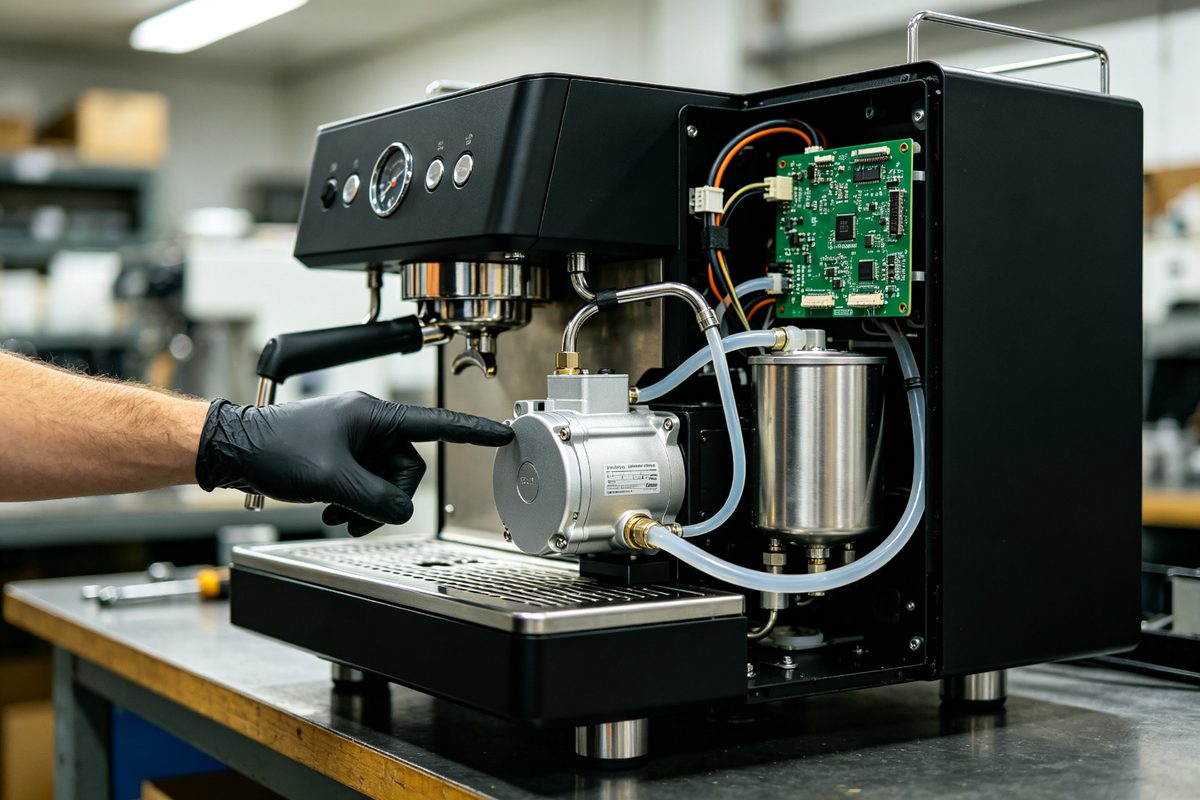 Inside an espresso machine: pump, heating system and control board should be specified at model level and reviewed with their mounting, water path and validation evidence.
Honest Advice: When Vibration Pumps Are Actually the Right Choice
Not every machine needs a rotary pump. Select the pump architecture to match the product’s intended duty cycle, water configuration, service concept and price position. Require a model-specific pressure/flow, noise and endurance plan, and ensure the product positioning does not promise performance the design cannot demonstrate.
Boiler vs Thermoblock: Temperature Stability Is Everything
The same component-first review is useful beyond coffee machines; our air fryer internal components guide shows the questions to ask about heating, controls and service parts.
After the pump, the heating system is a key sourcing decision. It affects warm-up, temperature behaviour during the intended beverage recipe, steam capacity, energy use and service needs. Two common designs are boilers and thermoblocks.
Stainless Steel Boilers
A boiler is a sealed heated-water reservoir. Its capacity, materials, heating control, thermal insulation and service requirements vary by machine; specify these values for the exact model.
Advantages:
- Thermal mass and control design can support stable performance when validated under the intended recipe
- Recovery behaviour should be measured after the defined brew/steam sequence
- Can maintain both brew and steam temperatures simultaneously (in dual-boiler designs)
- Service life depends on material, water quality, design, maintenance and use profile
- Better for milk drinks — steam power is consistent
Disadvantages:
- Warm-up time must be measured for the final configuration
- System cost must be quoted for the specified component and volume
- Larger and heavier — requires more internal space
- Energy consumption — keeps water hot continuously (unless auto-off)
- Scaling risk and maintenance interval depend on water chemistry and the manufacturer’s documented service plan
Thermoblocks (Thermoblock / Flash Heater)
A thermoblock heats water on demand as it flows through a heated aluminum or stainless steel block. There is no stored hot water — the water is heated instantly as it passes through the thermoblock’s channels.
Advantages:
- Warm-up can be evaluated against the product’s target beverage experience
- Component and system cost must be quoted for the specified material and volume
- Compact and lightweight — fits in small machines
- Lower energy consumption — only heats water when needed
- No standing hot water — less scale buildup in the heater itself
Disadvantages:
- Temperature and recovery performance must be measured under the intended recipe and sequence
- Steam performance should be tested where milk drinks are in scope
- Food-contact materials must be assessed under the applicable EU food-contact framework and intended use
- Durability and scaling resistance require model-specific validation and service evidence
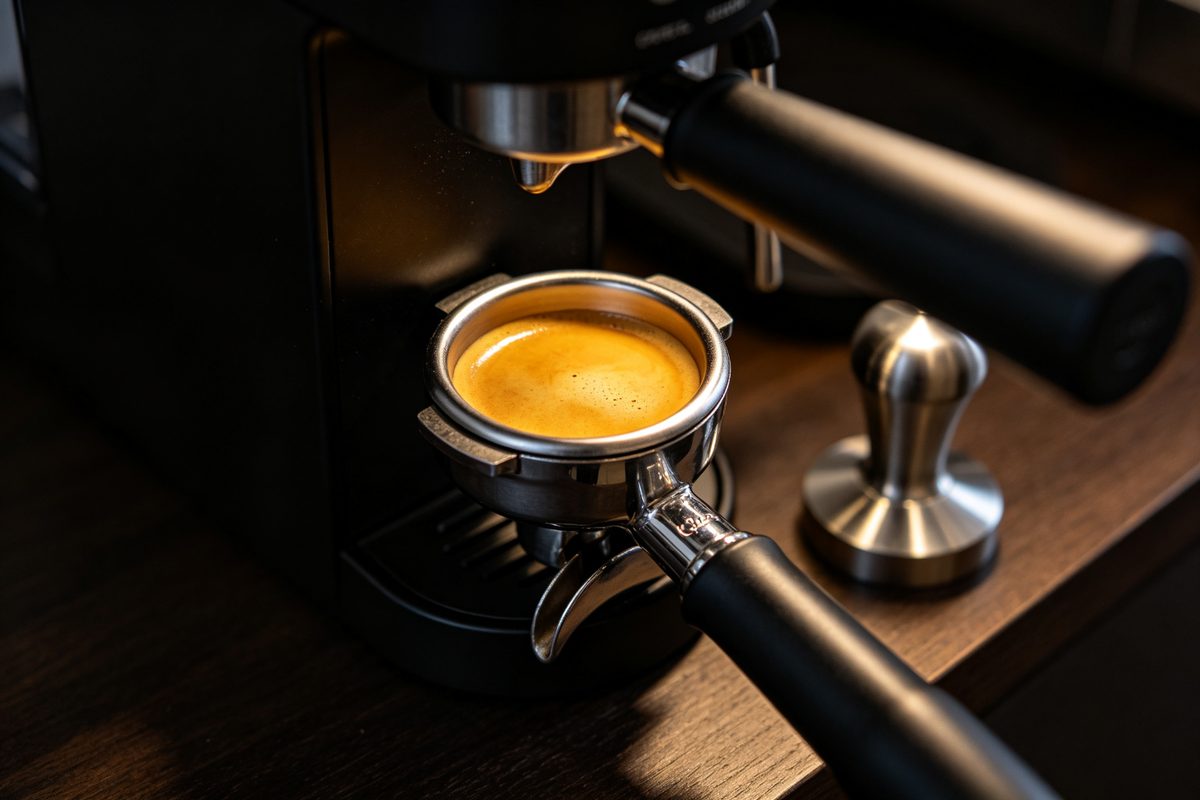 Extraction quality depends on the complete machine system: recipe, temperature control, pressure/flow behaviour, coffee, grinder setting and maintenance. Validate performance using a documented product test method.
| Component | Entry Position | Mid Position | Premium Position |
|---|---|---|---|
| Pump | Specify exact model, mounting and validation target | Specify performance and service evidence | Specify performance, service and sustained-use evidence |
| Heating | Specify material, control and warm-up target | Specify recipe performance and service plan | Specify thermal performance and sustained-use validation |
| Brewing Unit | Fixed (non-removable) | Removable (Saeco-style) | Removable + metal gears |
| Grinder | Specify grind consistency and cleanability target | Specify burr material and adjustment validation | Specify performance, material and service evidence |
| Control | Mechanical thermostat | Digital + NTC sensor | PID controller + dual NTC |
| Quality evidence | Component BOM and model test plan | Test results, service plan and pilot feedback | Expanded validation and documented support plan |
The Brewing Unit (Bean-to-Cup Machines)
Brewing-unit access should be planned together with the warranty and replacement-parts programme; see spare parts and after-sales planning.
In bean-to-cup (super-automatic) machines, the brewing unit is the mechanism that takes ground coffee, compresses it into a puck, extracts espresso, and then ejects the used puck. This is the most complex mechanical component in the machine and a major driver of reliability and maintenance cost.
Removable vs Fixed Brewing Units
Removable brewing units (Saeco-style, used by Philips, Jura entry models, and many Chinese OEMs) can be removed by the user for rinsing under the tap. This is a significant advantage:
- User can clean weekly — reduces coffee oil buildup and mold risk
- Can make routine cleaning accessible to the user when the instructions and design permit it
- Easy to replace if worn — user can swap in 5 minutes
- Better for markets where service centers are scarce
Fixed brewing units are built into the machine and cannot be removed by the user. They are cheaper to manufacture but:
- May require service access for cleaning, depending on the design and maintenance instructions
- Cleaning intervals and hygiene risks should be addressed in the documented maintenance plan
- Higher long-term cost of ownership
- Customers report “the machine started tasting bad after a few months”
Brewing Unit Materials and Gears
The brewing unit uses gears to drive the compression mechanism. Gear material, geometry, lubrication, load and cleaning conditions affect durability. Require a component specification and model-level endurance evidence rather than assuming life from material alone.
The brew chamber itself should be made of food-grade plastic (PBT or Tritan) with stainless steel filter screens. Avoid machines with unmarked plastic brew chambers — they may not meet LFGB or FDA food contact requirements.
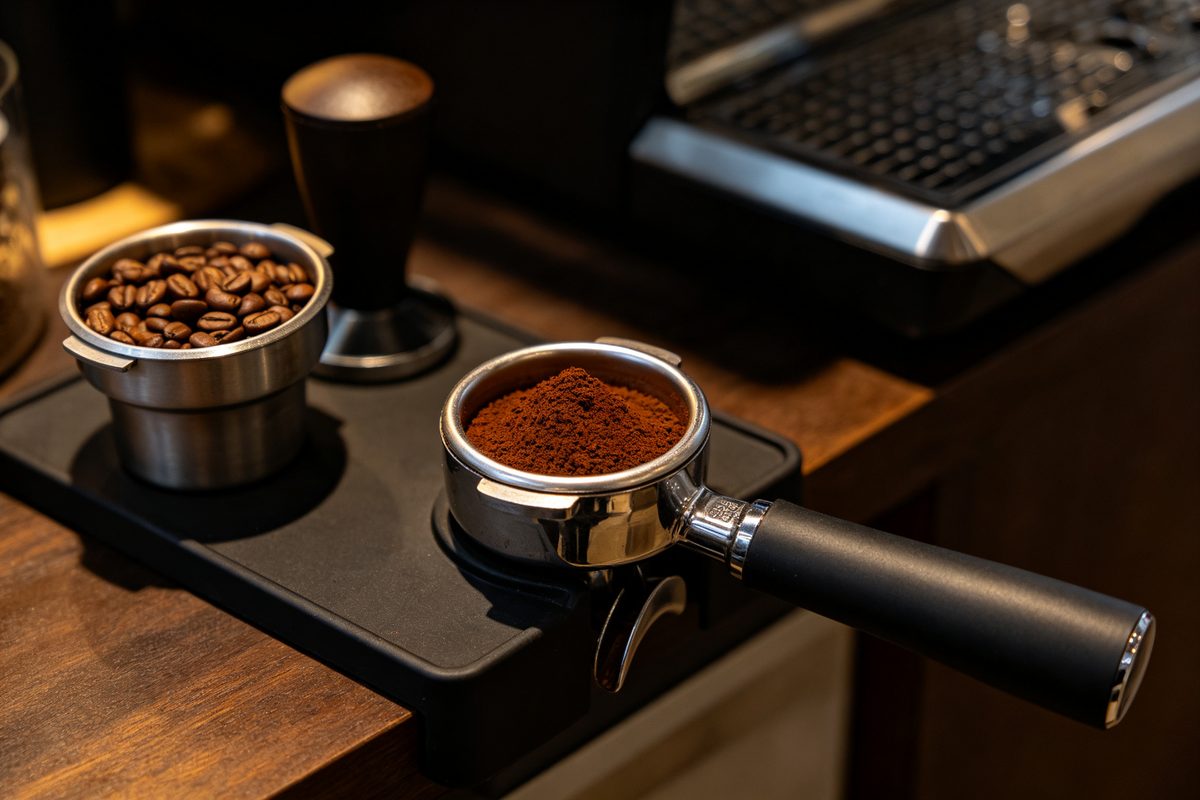
The Grinder: Burr Quality Defines Bean-to-Cup Performance
For a consumer-facing example of how product operation and cleaning guidance should be communicated, see the how to use a blender guide.
In bean-to-cup machines, the integrated grinder is what separates “convenient” from “actually makes good coffee.” A bad grinder will produce inconsistent particle size, causing channeling (water finds the path of least resistance through the puck), weak extraction, and poor crema — no matter how good the pump and boiler are.
Conical Burr Grinders (Recommended)
Conical burrs use two cone-shaped grinding surfaces — one rotating inside the other. They produce a uniform grind with minimal heat generation (friction heat can burn coffee oils, making the coffee taste bitter).
Stainless steel conical burrs: A common option. Assess burr geometry, grind consistency, wear, adjustment repeatability and cleanability for the exact model.
Ceramic conical burrs: Evaluate grind performance, brittleness risk, foreign-object tolerance and replacement/service plan for the intended use.
Blade Grinders (Avoid for Espresso)
Blade grinders use a spinning blade to chop beans and normally provide less controlled particle size than a burr grinder. For an espresso proposition, define grind-consistency targets and validate them with the intended beans and recipe before finalising the grinder choice.
Grinder Settings and Capacity
Look for machines with at least 8 grind settings (15+ is better). This allows the user to adjust for different bean roasts and tastes. The grinder hopper should hold at least 200g of beans (250-300g is standard). Avoid machines with hoppers under 150g — customers will complain about refilling too often.
5 Coffee Machine Sourcing Mistakes That Increase Return Rates
- Choosing a pump by label rather than system evidence. Match the pump, mounting, water path and service plan to the claimed duty cycle; verify pressure/flow, noise and endurance on the final configuration.
- Using an aluminum thermoblock without food-safe coating. Aluminum can leach into hot water, and EU regulators are increasingly scrutinizing aluminum in food contact materials. Use stainless steel thermoblocks or coated aluminum, and request the LFGB test report.
- Fixed brewing unit without a workable maintenance plan. Where the user cannot access the unit, document the cleaning method, service interval, service access and spare-part plan.
- Grinder choice without recipe validation. Define grind consistency, adjustment range and beverage test criteria before claiming espresso performance.
- Not verifying the component BOM against the sample. The sample may have a Fluid-o-Tech rotary pump, but mass production may switch to a no-name Chinese pump without telling you. Write the component brand and model into the purchase contract, and inspect the first production run.
How to Verify a Supplier’s Coffee Machine Capability
Before placing an order, verify that the supplier actually understands coffee machine components and can deliver consistent quality. Ask these questions during the audit or RFQ phase:
- Can you provide the full component BOM with brand names? A reputable supplier will give you pump brand (Ulka/Fluid-o-Tech), boiler material (SS304/SS316), brewing unit type, and grinder burr material. If they say “we use good quality parts” without specifics, walk away.
- What is the pump-life validation plan? Ask for the exact pump model, test water, duty cycle, sample size, pass/fail criteria, failures observed, and the complete report. Do not accept a generic cycle-life promise.
- Do you have LFGB/FDA food contact certificates for the brew chamber and water path? All parts that contact water or coffee must be food-safe. Request the actual test reports, not just a claim.
- Can I remove and inspect the brewing unit? If the supplier won’t let you open the machine during the factory audit, they may be hiding cheap components. A transparent supplier will happily show you the internals.
- What field-quality evidence is available for comparable models? Request traceable warranty/return data, failure modes, sales period, markets and corrective actions. Compare like-for-like models and use conditions.
Coffee Machine Sourcing Checklist
If the product is planned for Great Britain, include the documentation review in your UKCA compliance for kitchen appliances workstream.
- ☐ Pump type specified in contract (vibration brand: Ulka/CEME; rotary brand: Fluid-o-Tech/Procon)
- ☐ Heating system specified (thermoblock material: SS/aluminum; boiler: SS304/SS316, capacity)
- ☐ Brewing unit type (removable vs fixed) and gear material (plastic vs metal)
- ☐ Grinder type (conical burr: SS/ceramic; number of settings; hopper capacity)
- ☐ Control system (mechanical thermostat vs digital NTC vs PID)
- ☐ LFGB/FDA food contact certificates for all water-path components
- ☐ CE/ETL/CB/RoHS certificates for the complete machine
- ☐ Pump lifespan test data (cycle count to failure)
- ☐ Temperature stability test data (±°C during extraction)
- ☐ Steam power test (time to froth 200ml milk to 65°C)
- ☐ Component BOM matches the approved sample (inspect first production run)
- ☐ Spare parts availability (pump, boiler, brewing unit, grinder burrs) for 5 years
- ☐ Traceable field-quality data for comparable models, with failure modes and corrective actions
- ☐ Customization options: logo, control panel UI, color, plug type, language
- ☐ MOQ, sample lead time, mass production lead time, and payment terms confirmed
Next Steps: From Spec Sheet to First Order
Before confirming shipment terms, align the purchase order with the Incoterms for kitchen appliance importers guidance.
Sourcing a coffee machine is not only about the headline price. Use this guide to verify the component BOM, define product-performance and service expectations, and review validation evidence before committing to production.
Get the Coffee Machine Component Spec Comparison Sheet
Want to compare pump, heating and grinder options side by side? Contact APEXDURA to discuss component specifications, model-level validation inputs and your target product position.
APEXDURA manufactures espresso and bean-to-cup coffee machines with component choices matched to your target price point. We use Ulka/CEME vibration pumps for budget models and Fluid-o-Tech rotary pumps for premium models, stainless steel boilers, conformal-coated control boards, and removable brewing units. We provide full component BOMs and test reports during the sampling phase.
Frequently Asked Questions
Q: Can I upgrade from a vibration pump to a rotary pump after tooling is complete?
A: Sometimes. A pump change can affect the water path, mounting, power supply, safety assessment and tooling. Discuss it during the design phase and obtain a model-specific engineering and tooling impact assessment before approving the change.
Q: What is the minimum order quantity for coffee machines with custom components?
A: MOQ varies by supplier, component availability, customisation, tooling and production plan. Obtain a written, current quotation before investing in design or tooling work.
Q: How long does it take to develop a custom coffee machine from concept to mass production?
A: Typical timeline: 2-4 weeks for design and spec finalization, 4-6 weeks for first prototype, 4-6 weeks for testing and revisions, 4-6 weeks for tooling (if custom), 4-6 weeks for first production run. Total: 4-6 months for a fully custom machine. Standard models with minor customization can be ready in 6-8 weeks.
Q: What certifications do I need for coffee machines sold in the EU?
A: For EU sales, determine the applicable legislation for the exact model, including electrical-safety, EMC, RoHS, and food-contact obligations where relevant. Food-contact parts should be assessed against the EU framework in Regulation (EC) No 1935/2004 and any applicable material-specific measures; do not treat “LFGB” as a universal product certificate. For the UK and North America, requirements depend on the product, supply route, and market. Confirm the current scope with the importer, accredited laboratory, or qualified compliance adviser before placing the model on the market.
About Us
Zhongshan Zhenmei Electrical Appliance Co., Ltd. is a premier OEM/ODM partner specializing in the manufacturing of kitchen appliances, including air fryers, electric pressure cookers, blenders, and more. With over 16 years of expertise, we transform concepts into high-quality, market-ready products for leading global brands.
Media Contact
Company Name: Zhongshan Zhenmei Electrical Appliance Co., Ltd.
Contact Person: Media Relations
Email: Send Email
Country: China
Website: https://www.apexdura.com/


