
Natural Imaging at 798: Landscapes as Archives, Bodies as Terrain
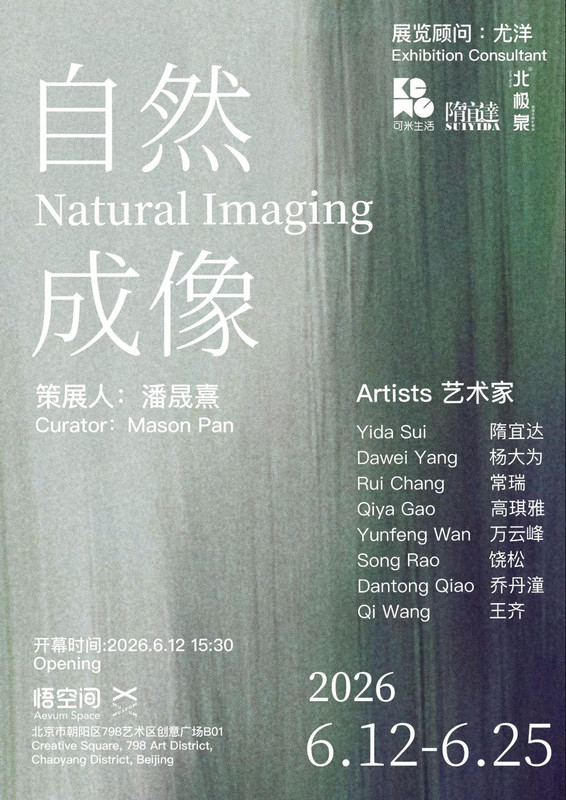
Natural Imaging
Creative Square B01, 798 Art District, Beijing 12–25 June 2026
Curator: Mason Pan
Exhibition Consultant: Yang You
What does it mean for nature to produce its own image? Not a photograph of a forest, not a painting of a coastline, but the landform itself as a record, the weathered rock face as an archive, the path a river has worn into bedrock as a kind of self-inscription. This question, at once deceptively simple and genuinely open, organizes Natural Imaging, a group exhibition of nine artists now on view at Creative Square B01 in Beijing’s 798 Art District, curated by independent curator and art researcher Mason Pan.
Pan’s framing is precise: natural history is the imaging of nature. Landscapes are not backdrops but outputs, produced by the slow accumulation of temperature, pressure, moisture, and time. The exhibition takes this premise seriously, gathering artists whose practices span millinery, photography, sculpture, installation, performance, and painting, and whose works, while formally diverse, share an inquiry into how images form, what they carry, and who or what does the forming.
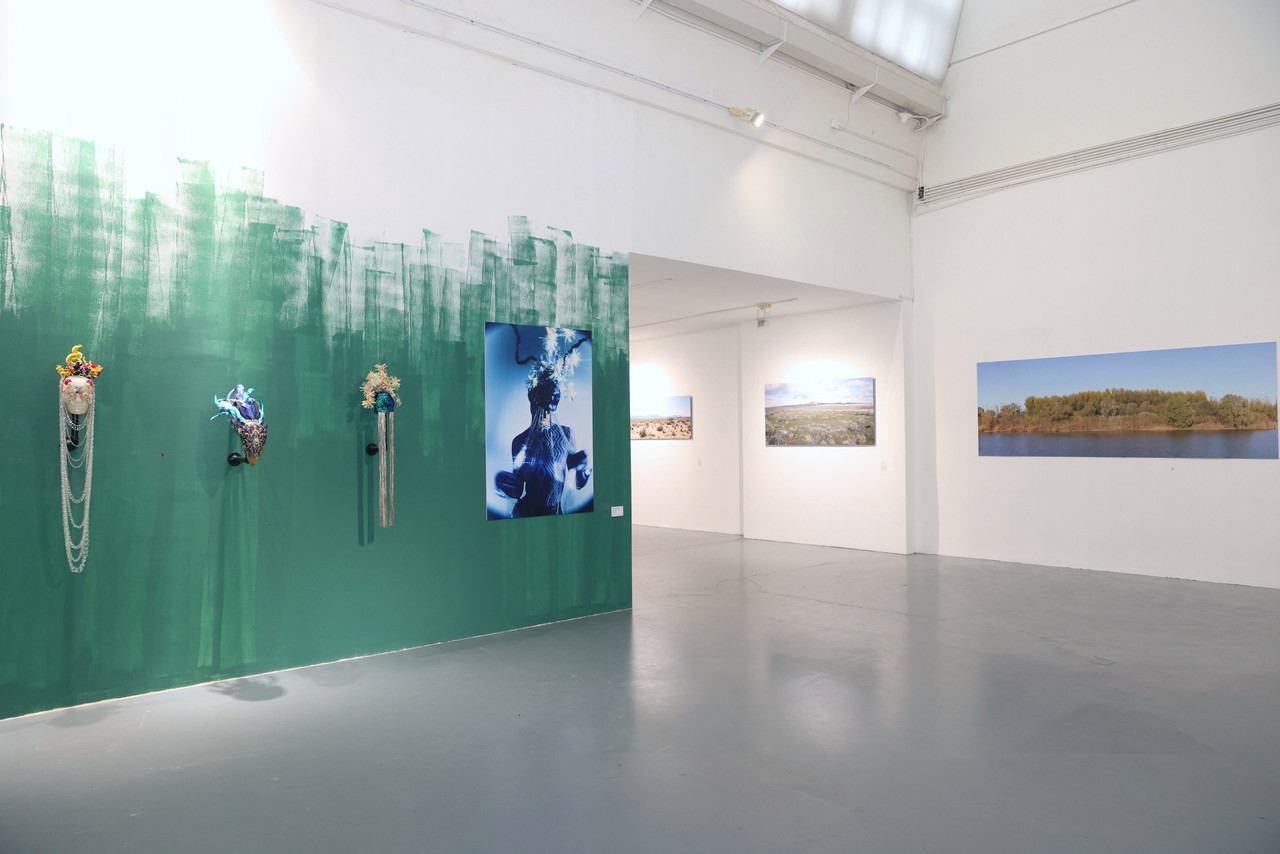
The show opens with a provocation. Dawei Yang’s large-format photographs (90 × 188 cm) look, at first glance, like the kind of images you might find in a nature magazine: wide expanses of apparently uninhabited terrain. But Yang, a photographer trained at the Central Academy of Fine Arts, is not offering landscape for its own sake. Printed at near-documentary scale and resolution, each image rewards close reading with details that refuse the romantic premise. Human traces are everywhere, small, unremarkable, and embedded so naturally into the terrain that they register as geological fact. Yang’s project is a sober one: in the Anthropocene, he suggests, “looking at nature” is no longer an act of romantic contemplation. It is an act of self-implication.
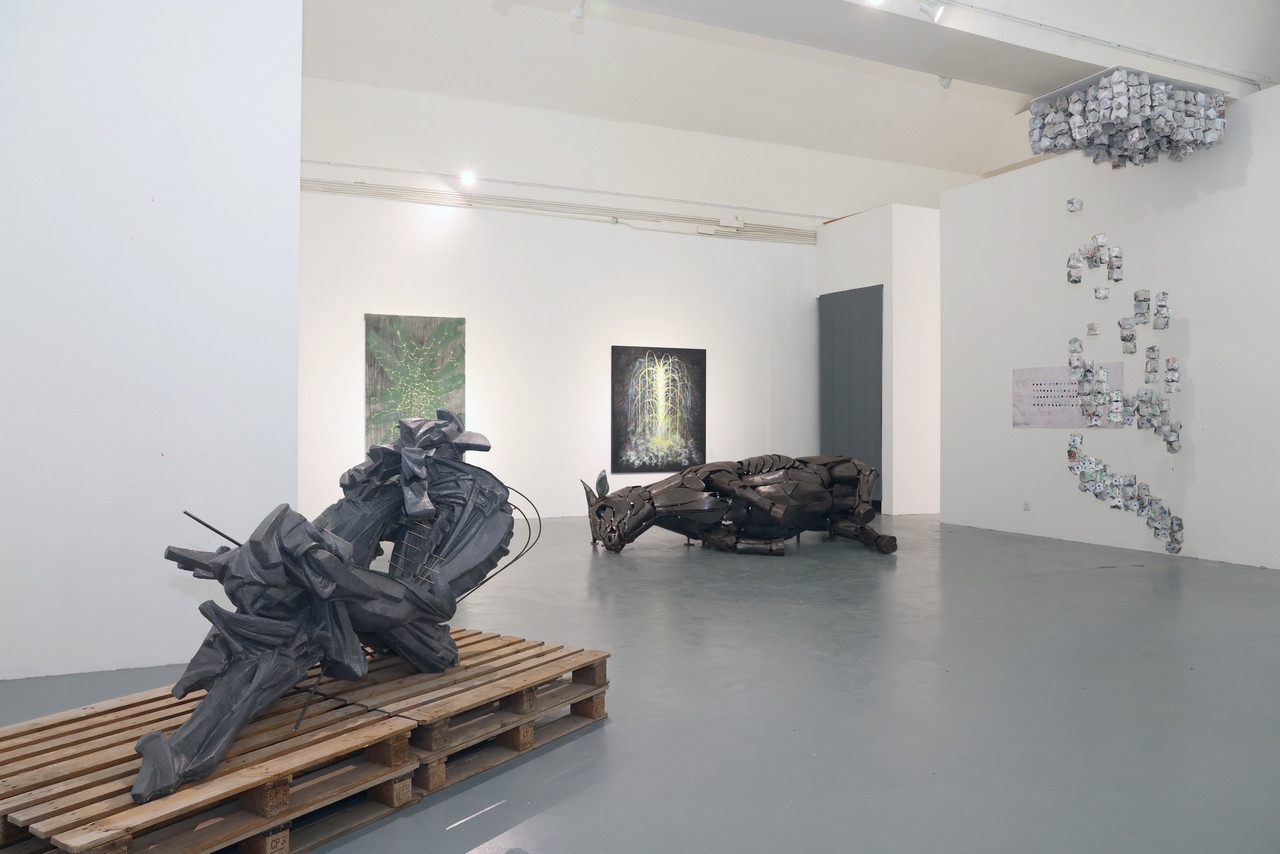
Song Rao takes a more architecturally scaled approach to the same problem. His installation TOXIC THROAT (2022) stacks discarded cigarette packs into a structure that reads, from a distance, as a fractured skyscraper. The formal conceit is compact and legible: consumption accumulates into landscape. The companion work CO2H2O (2022) translates NASA sea-level projections and UN emissions data for 2020–2100 into a room-filling visual form that makes abstract futures feel spatial and present. Together, Rao’s works operate as a kind of environmental accounting, translating the invisible into something that demands to be looked at.
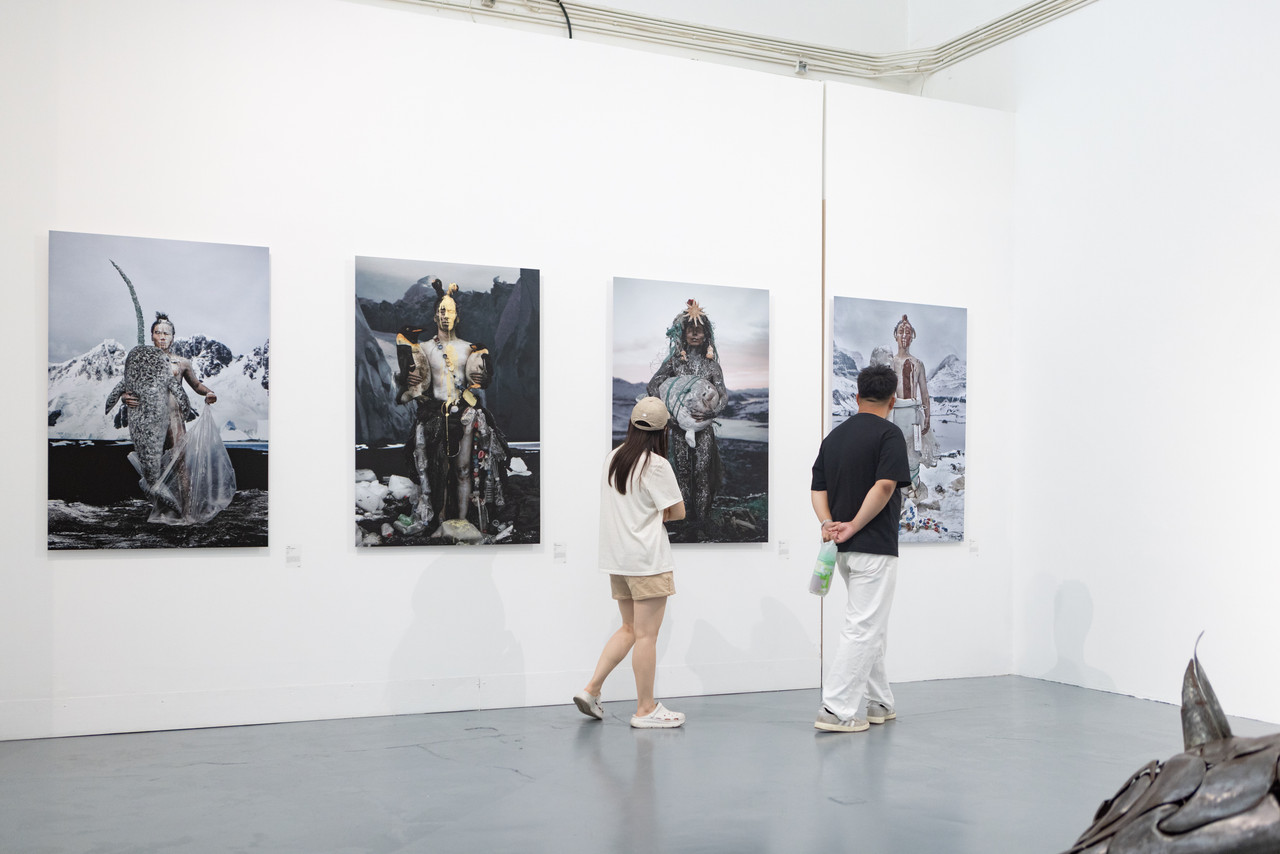
Yunfeng Wan’s Melting series (2023) brings a different register entirely. Wan, who has traveled to both the Arctic and Antarctic and is widely credited as the first Chinese environmental performance artist to be featured in the international edition of Vogue, uses his body as medium, combining body painting, polar landscapes, and environmental installation to make glacial retreat viscerally tangible. His photographs from these performances, on view here as large-format prints, document actions staged in environments of extraordinary fragility: they are images made at the threshold of disappearance.
The exhibition’s treatment of the body as landscape extends to Sui Yida’s millinery. Best known as one of China’s most prolific celebrity headpiece designers, with commissions spanning Fan Bingbing and Yang Liping, Sui presents two works from distinct periods that anchor the show’s more conceptual territory in craft and material specificity. Insect (2022), constructed from polyester and PET fibers, captures a moment of suspended organic tension: the peak of internal energy before eruption, each tubular structure extending outward like life caught at its own critical threshold. I’m Fine (2019), the work that launched Sui’s public-awareness series on depression and mental health, imagines an inverted figure from whose face blooms a flourishing bouquet while colorful teardrop-shaped stones hang below. The headpiece is simultaneously theatrical and quietly devastating. As a vehicle for social commentary, it is more direct than most painting.
The sculptural work in the exhibition tends toward the durational and the uncertain. Rui Chang, a graduate student in Sculpture at the Central Academy of Fine Arts, contributes Cease and Live (2026), a kinetic metal sculpture in which an ox form, laid on its side, registers the relationship between individual life and the structures that condition it. The cold rigidity of metal against the implied warmth of the animal, the fractured structure set into subtle motion by an embedded motor: Chang is working in the space between personal memory and structural analysis, and the result is unsettling in the most precise sense. Qiya Gao’s X-Life Cycle (2026), cast in lead and resin and standing over two meters tall, presents two figures caught between human and animal form, locked in a loop of biting, devouring, and expulsion. There is no fixed beginning or end to their movement: origin and conclusion collapse into each other. It is among the most formally ambitious works in the show, and one of the most viscerally uncomfortable.
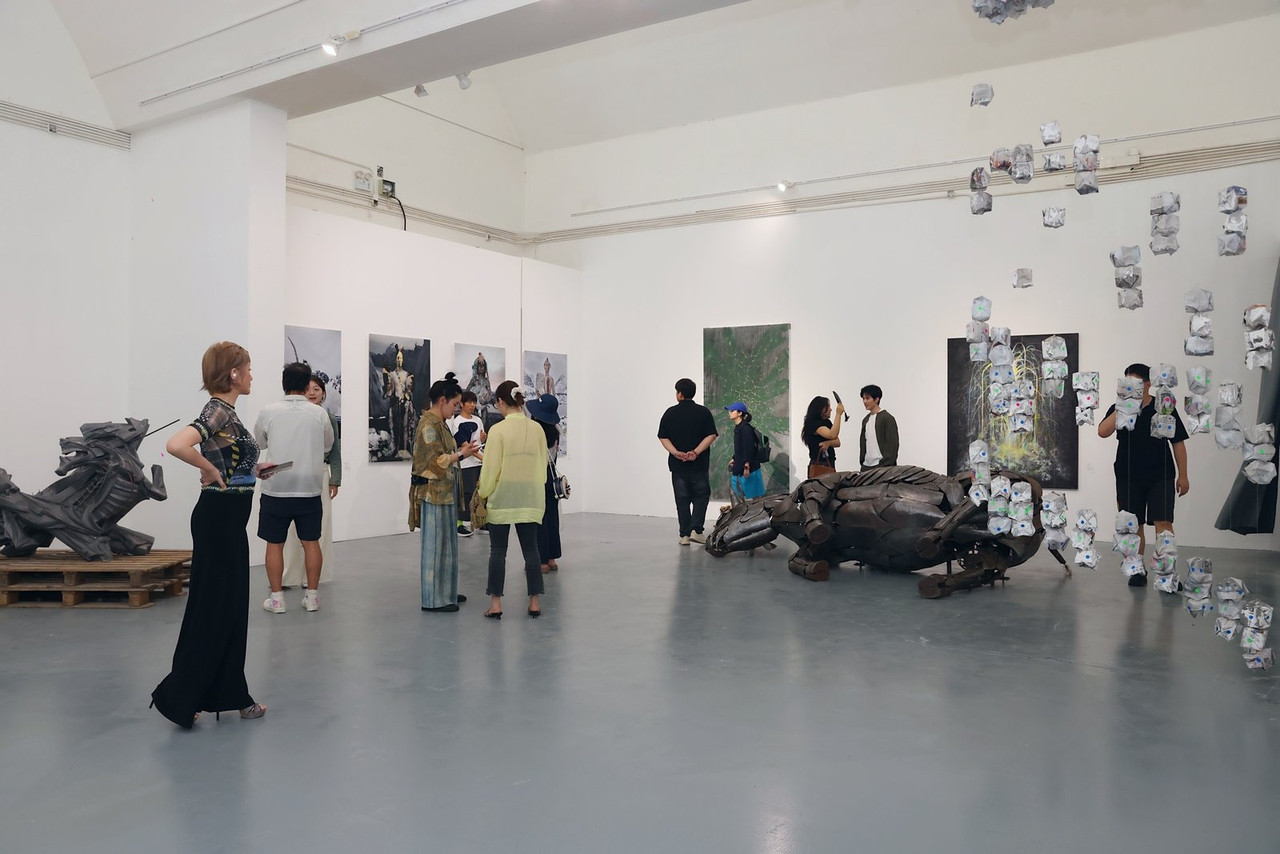
The painting component introduces a younger generation of Central Academy students whose works, individually modest in scale, accumulate into something surprisingly coherent. Dantong Qiao’s two canvases bring together a refined ecological observation and a careful attention to emotional structure. Crown Shyness (2025) draws on the phenomenon in which tree crowns maintain distance from neighboring canopies, producing gaps of light rather than shade, and transforms this into a meditation on the self-protective intelligence of emotional distance. Yang He Qi Zhe (2026), its larger companion, renders the ancient Chinese phrase about spring warmth awakening dormant life as an abstract composition of looping forms and expanding gold, in which what begins as a cycle of confusion gradually discloses itself as the very form of emergence.
Qi Wang’s Inner Echo (2026) takes the glass bottle as its organizing metaphor: vision filtered through a curved surface, the world bent and refracted by the instrument through which it is observed. Encaustic and oil on board, the work builds its surface to a physical density that makes the act of looking feel genuinely effortful, which is, one suspects, the point. For Wang, to look outward is always, simultaneously, to look inward.
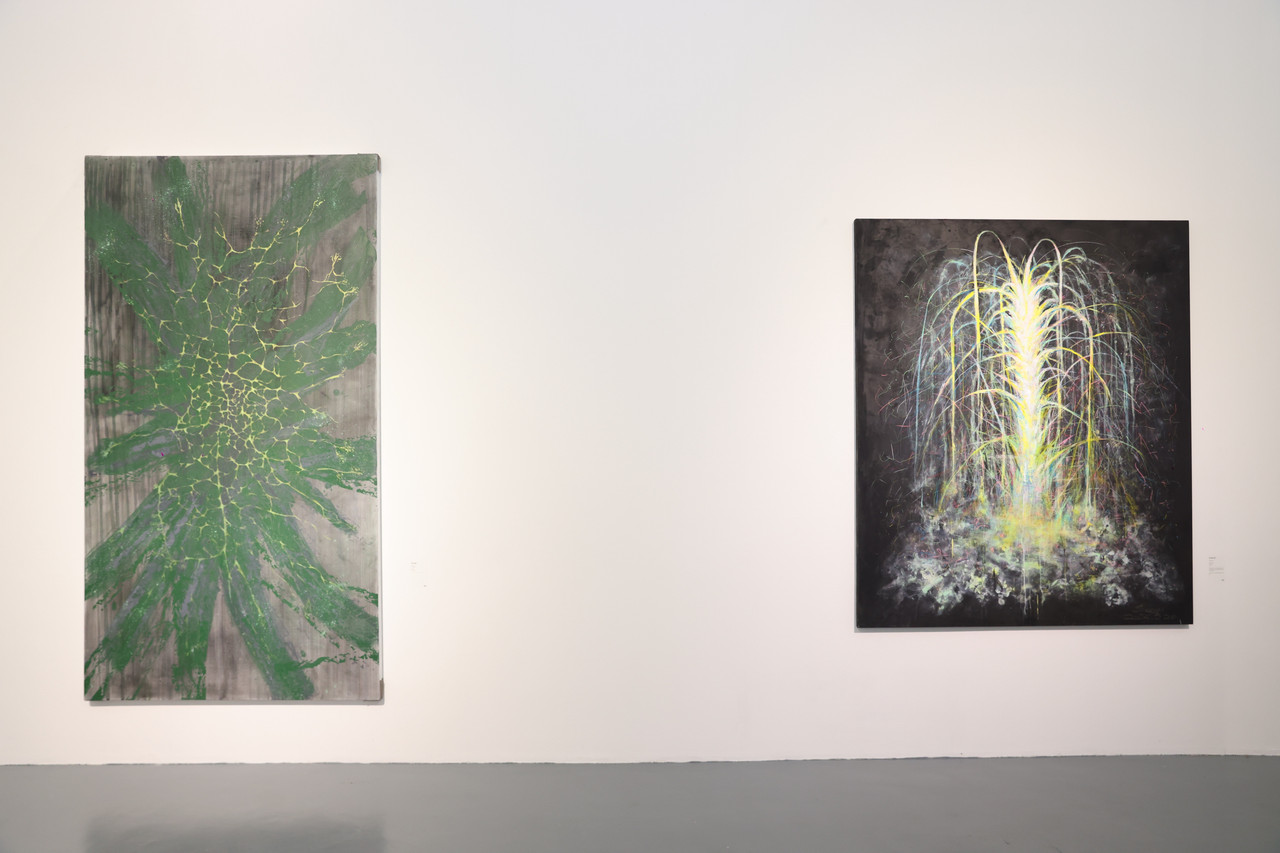
Enyu Si’s contribution, Wish Upon a Shooting Star (2026), is the most overtly expressive work in the show: acrylic and pastel on canvas, warm and energetic, depicting the convergence of countless wishes into a single beam of light against a dark ground. It sits at the exhibition’s more intimate, human-scaled end, and its directness earns it a place alongside works that are more formally complex.
The curatorial logic of Natural Imaging is generous without being vague. Mason Pan, who has previously organized exhibitions at 798 and in New York, and who advises on the board of X Museum, has assembled works that speak to each other without being coerced into a single argument. The show neither romanticizes nature nor simply documents its deterioration. It takes seriously the idea that imaging is a form of relation, that to make a picture of something, whether in photography, sculpture, performance, or paint, is to enter into a particular kind of contact with it.
The result is a show that asks its audience to recalibrate the act of looking, not as passive receipt, but as active participation in the ongoing work of understanding what we are made of, what we are making, and what, slowly, is being unmade.
Natural Imaging is on view at Creative Square B01, 798 Art District, Chaoyang District, Beijing, from 12 to 25 June 2026.
Media Contact
Company Name: Emergent Digital
Contact Person: Jessie E.
Email: Send Email
Country: United States
Website: emergentpr.com


