
Carlos Raposo Coaching Highlights Hidden Execution Reliability Risks That Emerge Under Organizational Pressure
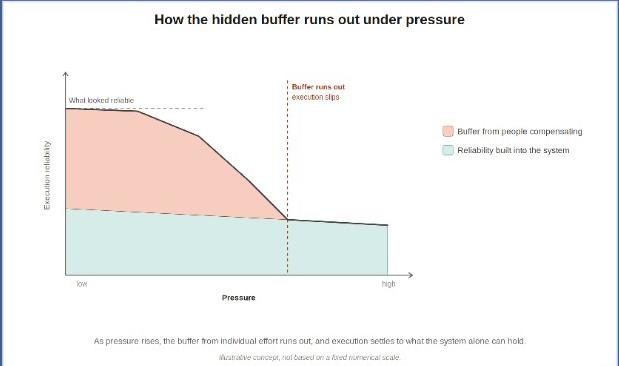
Organizations lose execution reliability under pressure because pressure does not create new weaknesses. It exposes the ones already built into the system. During calm periods, capable people quietly absorb gaps in coordination, ownership, and decision flow, so the organization looks dependable. When pressure rises, that absorption runs out, and execution that seemed reliable starts to slip in ways leaders rarely trace back to the system itself.
Why Execution Looks Reliable Until Pressure Hits
In normal conditions, every organization carries a hidden buffer. There is enough time, attention, and goodwill for people to work around the gaps in how decisions get made and how work moves between functions. The system looks reliable, but a lot of that reliability is being supplied by individuals quietly compensating.
That buffer is invisible precisely because it is working. No one notices the manager who smooths over an unclear handoff or the lead who chases down a stalled decision. The work gets done, so the system appears sound. What no one sees is how much of that performance depends on people absorbing strain the system should be carrying itself.
What Execution Under Pressure Actually Tests
Execution under pressure is not a test of talent or effort. Your people were already working hard. It is a test of whether the system holds once the buffer is gone.
When pressure rises, the slack disappears first. There is no longer time to chase the stalled decision or smooth the messy handoff. The moment that compensation stops, the underlying condition shows itself: decisions stall, communication degrades, and alignment drifts across teams. The reliability you thought you had was borrowed from individual effort, not built into the system, and pressure is simply the moment the loan comes due.
How Latent System Weaknesses Surface Under Stress
Most declines in organizational performance under stress follow the same pattern. The weaknesses were always there. Pressure just makes them visible and expensive at the same time.
Decisions that used to resolve informally now stall, because there was never a clear owner, only a person willing to step in. Handoffs that worked by goodwill start dropping, because the goodwill is now spent on survival. And small misalignments that were tolerable at a slower pace compound quickly once the pace increases. None of these are new problems. They are old conditions finally operating without their hidden buffer.
Why Most Leaders Misdiagnose What Happened
When execution slips under pressure, the natural reaction is to blame the trigger or the team: the big contract, the crisis, the reorganization, or the people who could not keep up. But the pressure did not cause the breakdown. It revealed a condition that was already present.
This misdiagnosis is costly because it points the fix in the wrong direction. Leaders respond with more effort, more meetings, and more pressure on the same people who were already absorbing the strain. That might buy a few weeks. It does not rebuild reliability, because the system underneath is still depending on individual compensation to function.
How to Build Execution Reliability That Holds Under Pressure
Reliable execution under pressure comes from building the conditions into the system, so performance no longer depends on people quietly absorbing its gaps. In practice that means a few things:
-
Clear decision rights, so choices resolve at the right level instead of waiting for someone to step in.
-
A synchronized cadence, so functions move on a shared rhythm rather than relying on informal coordination.
-
Alignment that holds across teams, so small misalignments are caught early instead of compounding once the pace rises.
The first step is honest diagnosis: find where your current reliability is actually being supplied by individuals rather than the system. Those are the points that will fail first when pressure rises.
There is an advantage hiding in this work. When pressure hits an entire market, most organizations fragment at the same time. The ones whose execution is built to hold do not just survive the moment, they pull ahead while competitors are busy firefighting. Building reliability before you need it is how pressure becomes an advantage instead of a threat.
Frequently Asked Questions
Why does execution break down under pressure?
Execution breaks down under pressure because pressure exposes weaknesses that were already in the system. In normal conditions, people compensate for gaps in decision rights, ownership, and coordination. When pressure removes the slack that made that compensation possible, the underlying weaknesses surface as stalled decisions, dropped handoffs, and drifting alignment.
Does pressure cause organizational problems or just reveal them?
It mostly reveals them. Pressure rarely creates a new weakness. It removes the hidden buffer of time and attention that was masking an existing one. That is why the same organization can look reliable for years and then slip quickly once conditions tighten.
How do you build execution reliability that holds under pressure?
You build it by designing the conditions into the system rather than relying on individuals to absorb gaps. That means clear decision rights, a synchronized cadence across functions, and alignment that holds as pressure rises. The starting point is diagnosing where your current reliability depends on people compensating, because those are the points that fail first.
Media Contact
Company Name: Carlos Raposo Coaching, LLC
Contact Person: Carlos Raposo
Email: Send Email
Country: United States
Website: https://www.carlosraposocoaching.com


